
White Paper
Environmental Exposure and Reliability in Outdoor LED Signs
Executive Summary
Outdoor LED signs operate in some of the most demanding environments of any electronic system. Exposure to heat, cold, moisture, ultraviolet radiation, airborne contaminants, and temperature cycling places continuous stress on electronic components.
This white paper examines how environmental exposure impacts outdoor LED sign reliability and explains why enclosure design, sealing methods, and system architecture are critical to long-term performance.
Scope and definitions
This paper evaluates environmental factors that influence the reliability and service life of outdoor LED sign systems.
- Environmental exposure includes temperature extremes, moisture, humidity, ultraviolet radiation, and airborne contaminants
- Reliability refers to the ability of an LED sign system to maintain consistent operation and performance over time
- Thermal cycling describes repeated expansion and contraction of materials caused by temperature changes
- Ingress protection (IP) ratings define resistance to dust and water intrusion
- Environmental stress refers to the combined effect of multiple exposure conditions acting simultaneously on electronic components
Temperature Extremes and Thermal Cycling
Outdoor LED signs experience wide temperature swings across seasons and daily operating cycles. Thermal cycling causes expansion and contraction of materials, stressing solder joints, connectors, and circuit boards.
Mechanism of Failure: Repeated thermal cycling creates mechanical stress at the interface of components with different coefficients of thermal expansion (CTE), such as where a ceramic resistor meets a fiberglass circuit board. This stress leads to solder joint fatigue and micro-cracking. [1]
Statistical Impact: Research indicates that solder joint voids—microscopic gaps formed during manufacturing or stress—significantly reduce thermal conductivity. Voiding greater than 50% is considered a major contributor to joint failure, as it prevents heat from escaping the LED die. [2]
Moisture, Humidity, and Condensation
Moisture ingress remains one of the leading causes of outdoor electronics failure. High humidity and condensation can lead to corrosion, short circuits, and degradation of conductive paths.
Ingress Risks: Ingress protection failures are especially common in ventilated or fan-cooled enclosures that rely on active airflow, which naturally draws in humid air. [3]
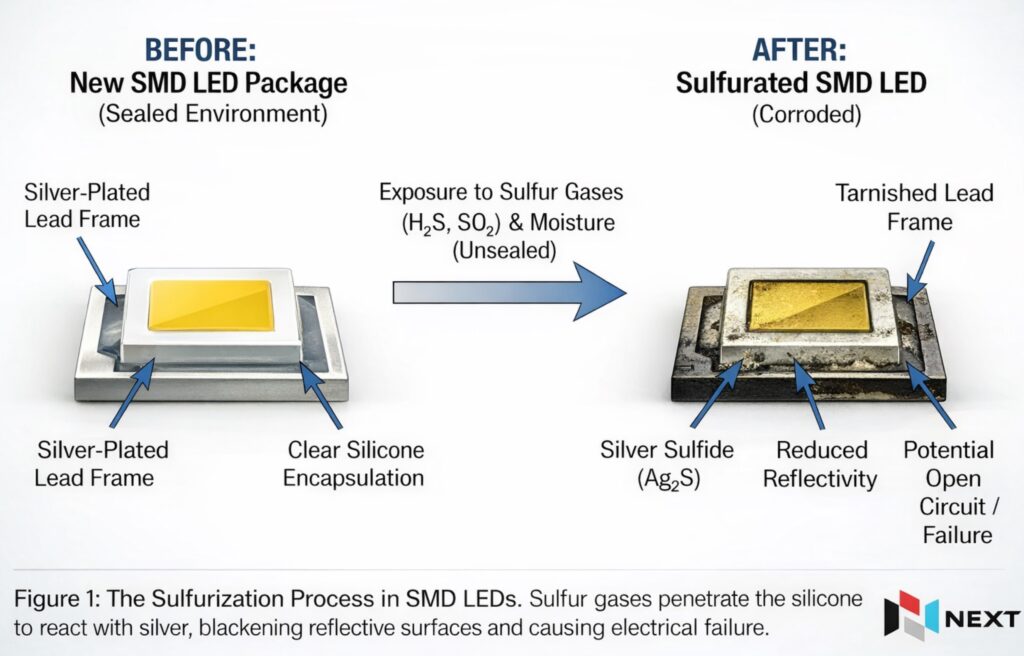
Corrosion Acceleration: When moisture combines with atmospheric pollutants such as sulfur or chlorine, it forms acidic compounds that rapidly corrode copper traces and silver-plated components. [4]
Dust, Airborne Contaminants, and Sulfurization
Airborne contaminants such as dust, salt, industrial pollutants, and vehicle emissions accelerate corrosion and insulation breakdown.
The Sulfurization Threat: Silver is commonly used in LED packages for its high reflectivity. In sulfur-rich environments, silver reacts to form silver sulfide, darkening reflective surfaces, reducing light output, and potentially causing electrical failure. [5]
Thermal Blockage: Accumulated particulates on electronic assemblies restrict heat dissipation, effectively insulating hot components and increasing operating temperatures. [6]
Ultraviolet Exposure and Material Degradation
Prolonged ultraviolet exposure degrades plastics, gaskets, and cable insulation used in outdoor enclosures.
Polymer Breakdown: UV radiation breaks chemical bonds in materials such as PVC and standard acrylic, causing discoloration, cracking, and loss of impact resistance. [7]
Material Selection: UV-stabilized polycarbonate retains structural integrity and optical clarity for more than 15 years in high-sunlight environments, significantly outperforming non-stabilized plastics. [8]
Ingress Protection and Enclosure Design
Ingress Protection (IP) ratings provide a standardized measure of resistance to dust and water intrusion.
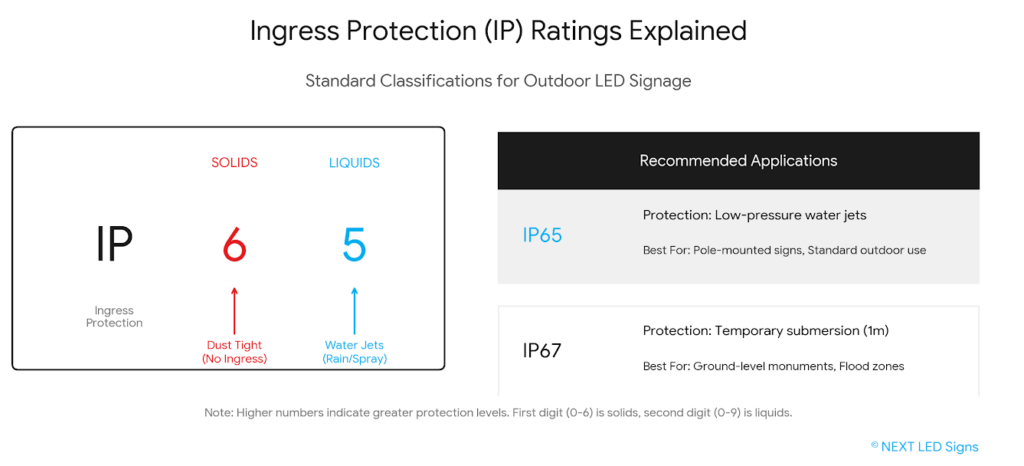
IP65 vs. IP67: IP65 enclosures are dust-tight and resistant to water jets, making them suitable for most polemounted nstallations. IP67 enclosures provide protection against temporary submersion and are better suited for ground-level applications. [9]
Maintenance Implications: Outdoor enclosures typically require gasket and seal replacement every 2–5 years depending on exposure. Sealed, solid-state designs with fewer access points significantly extend maintenance intervals. [10]
Environmental Stress as a Reliability Multiplier
Environmental factors interact to accelerate system degradation. Combined exposure to heat, moisture, and contaminants produces substantially higher failure rates than isolated stress conditions. [11]
Design Strategies for Environmental Reliability is improved through sealed, fanless architectures, corrosionresistant materials, and controlled thermal pathways. Designs that minimize air exchange while maintaining effective heat dissipation demonstrate longer service life and reduced maintenance frequency. [12]
Engineering Implications for Outdoor LED Sign Systems: environmental exposure must be treated as a primary design constraint. LED signs engineered to withstand temperature extremes, moisture, ultraviolet exposure, and airborne contaminants achieve higher reliability, lower maintenance costs, and more predictable long-term performance.
Limitations and Statement on Evidence
This white paper is based on publicly available technical standards, industry research, and established engineering principles related to outdoor electronic systems. Performance outcomes may vary depending on site conditions, materials, and system configuration. This document is intended for technical evaluation and comparative analysis and does not constitute a performance guarantee.
References
- IEEE Transactions on Device and Materials Reliability. Effects of Thermal Cycling on Electronic Assemblies.
- Cree LED. XLamp Solder-Joint Reliability: Impact of Voids and Thermal Shock.
- IPC. Moisture Sensitivity and Corrosion in Outdoor Electronic Systems.
- MAS Innovations. Corrosion Control for Control Rooms and Electronics.
- NASA NEPP. Silver Corrosion and Whiskers: Mechanisms in Electronic Assemblies.
- Reliability Engineering & System Safety Journal. Environmental Contaminants and Electronics Degradation.
- ASTM International. UV Degradation of Polymeric Materials Used in Outdoor Enclosures.
- ResearchGate. Evaluation of Long-Term Stability and Degradation of Polycarbonate.
- International Electrotechnical Commission (IEC). IEC 60529: Degrees of Protection Provided by Enclosures.
- Lianjie Enclosures. Indoor vs Outdoor Enclosures: Maintenance Frequency and Lifespan.
- National Institute of Standards and Technology (NIST). Combined Environmental Stress Effects on Electronics Reliability.
- U.S. Department of Energy (DOE). Environmental Design Considerations for Solid-State Lighting Systems.
Fast Facts
- 100,000 Hour Rating: Solid-state LEDs are engineered to last over 11 years of continuous operation.
- 75% Energy Savings: Digital signs use significantly less power than traditional outdoor lighting.
- 95% Testing Accuracy: Electrical measurements meet strict IES LM-79-19 confidence intervals.
Frequently Asked Questions
Most high-quality outdoor LED displays are rated for 100,000 hours of operation. This equates to approximately 11.4 years of continuous 24/7 use before the LEDs reach "half-life," where they begin to dim but do not necessarily fail.
Yes, provided they have a high brightness rating, typically measured in NITs. For visibility in direct midday sun, an outdoor sign should have a brightness of at least 5,000 to 7,000 NITs to maintain high contrast and readability.
Modern solid-state LED signs are highly efficient, often using 50% to 75% less energy than traditional neon or incandescent signage. Many signs also include light sensors that automatically dim the display at night to further reduce power consumption and light pollution.
To ensure longevity, it is recommended to wash the face of the sign every six months with a mild, non-abrasive detergent and water to remove dust and pollutants. Additionally, the ventilation and cooling systems should be checked annually to prevent debris buildup.
LEDs are actually more efficient in cold weather because the reduced heat stress extends the life of the semiconductors. In extreme heat, high-quality signs utilize internal thermal management systems to dissipate heat and prevent component degradation.