
White Paper
The Evolution of SMD Pixel Technology in Outdoor LED Signs
Executive Summary
Outdoor LED sign technology has historically forced buyers to choose between brightness, longevity, and visual resolution. For decades, the outdoor market was dominated by Dual In-line Package (DIP) technology—discrete LED lamps that delivered high brightness but were physically limited to coarse pixel pitches (typically 10mm or larger).
The maturation of high-brightness Surface-Mount Device (SMD) technology has eliminated this limitation. By integrating Red, Green, and Blue emitters into a single compact wafer, SMD architectures allow for pixel pitches to scale down from 10mm to as fine as 0.9mm. This engineering shift—often called the “Resolution Revolution”—enables outdoor displays to deliver high-fidelity imagery viewable from mere feet away, effectively merging the visual quality of indoor video walls with the weather resistance of outdoor signage.
Scope and definitions
This white paper uses the following scope and definitions for clarity and consistency.• SMD pixel: A surface-mount device package that integrates red, green, and blue LED emitters into a compact package mounted to the circuit board.
- DIP pixel: A through-hole (dual in-line package) LED architecture using discrete red, green, and blue lamps, generally associated with larger pixel packages and larger pixel pitch applications.
- Pixel pitch (mm): Center-to-center spacing between adjacent pixels; smaller pitch increases resolution and supports shorter viewing distances.
- Luminance: Display brightness typically specified in cd/m² (often referred to as nits).
- Lumen maintenance / L70: A lifecycle metric describing the time until light output declines to 70% of the initial value.
- Brightness headroom: Additional available luminance capacity that can be used to offset natural light-output depreciation over time via brightness control.
The Resolution Revolution
Breaking the 10mm Barrier
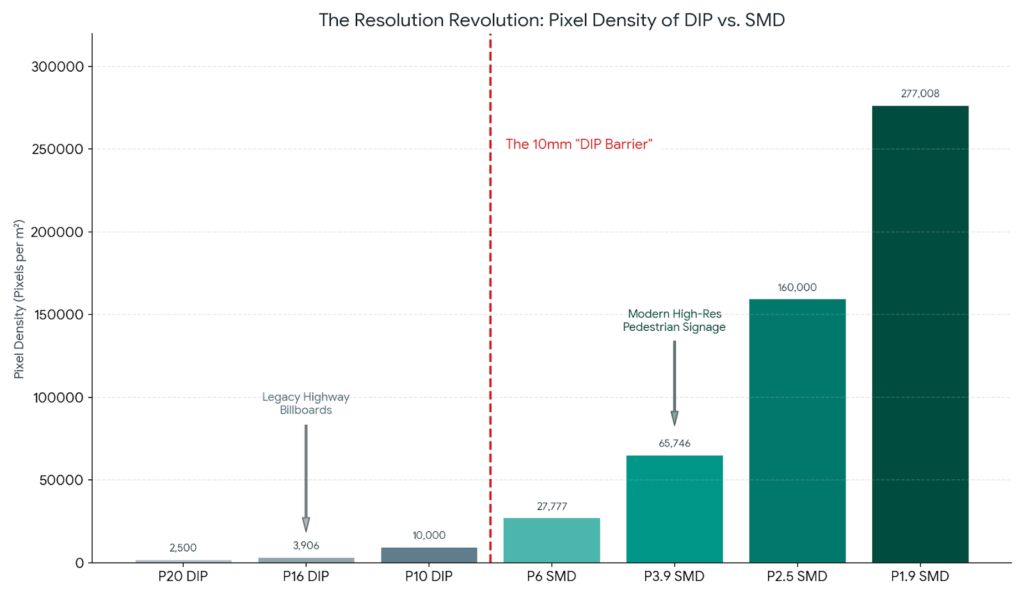
The most significant contribution of SMD technology to the outdoor market is the decoupling of brightness from physical size. In legacy DIP systems, each pixel required three separate light bulbs and three sets of soldering leads punching through the circuit board.¹ ² ³ ⁴ This physical footprint created a “hard floor” on resolution—manufacturers simply could not pack the lamps tighter than roughly 10mm apart without compromising structural integrity or heat dissipation.¹ ² ³
SMD technology removes this physical constraint by placing all three emitters inside a single, encapsulated package (commonly in 3535 or 2727 form
factors for outdoor use, and even smaller 1515 or 1010 packages for ultra-fine pitch).¹ ² ³ ⁵ ⁶
- DIP Limit: ~10mm Minimum Pitch (10,000 pixels/m²).¹ ² ³
- SMD Capability: ~0.9mm to 10mm Pitch (Up to 1,234,000+ pixels/m²).⁵ ⁶ ⁷
This 10x–100x increase in potential pixel density allows outdoor LED signs to display complex typography, detailed product photography, and high-detail video content that was previously difficult to render on legacy outdoor screens.⁵ ⁶ ⁷
Visual Acuity and Viewing Distance Impact
The shift to tighter pixel pitches fundamentally changes where an LED sign can be effective. The relationship between pixel pitch and viewing distance is governed by visual acuity limits. A standard industry rule of thumb is that the minimum viewing distance (in meters) is roughly equal to the pixel pitch (in millimeters).⁶ ⁷
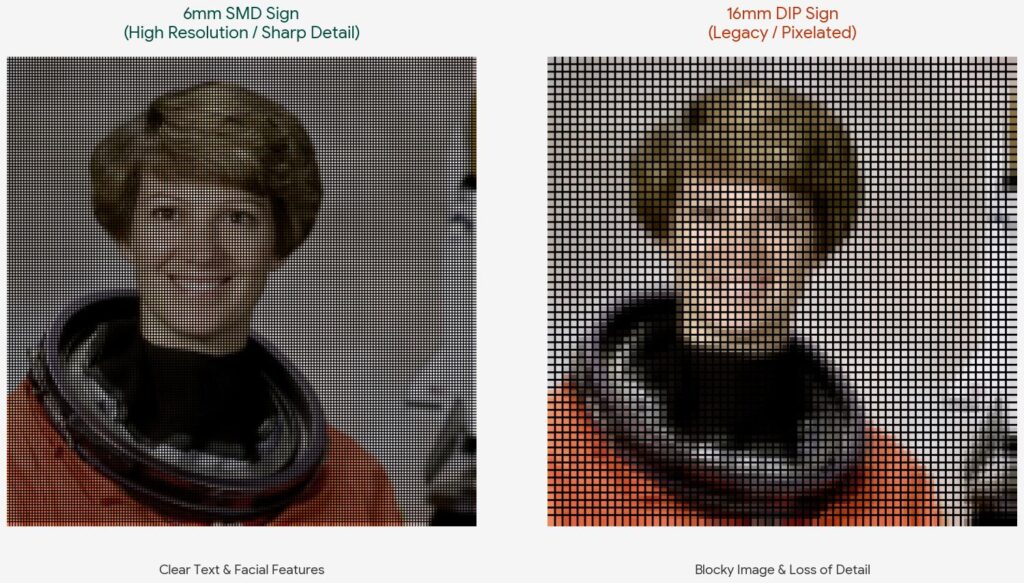
Legacy 16mm DIP Sign: Requires the viewer to be 16+ meters (52 feet) away to see a clear image. Anyone closer sees a grid of colored dots.⁶ ⁷
Modern 2.9mm SMD Sign: Becomes a seamless image at just 2.9 meters (9.5 feet).⁶ ⁷
By pushing pitch capability down to 0.9mm–2.5mm, SMD technology opens entirely new architectural applications: pedestrian-level kiosks, drive-thru menu boards, and street-level advertising where viewers are arm’s-length from the display.⁵ ⁶ ⁷
Outdoor visibility requirements and brightness headroom
Outdoor electronic displays must remain legible in high ambient light. Guidance for changeable/digital signs often expresses daylight luminance limits and targets in cd/m². Some roadway-focused guidance sets a daylight cap around 5,000 cd/m² for certain sign types and locations, with lower night-time limits.⁸ Other compendia of state rules for changeable message signs cite daylight luminance limits that can be substantially higher (for example, tens of thousands of cd/m² under bright illumination).⁹ Because outdoor luminance requirements vary by application and regulation, designers rely on brightness controland headroom so that light output can be adjusted over the service life as output naturally declines.¹⁰ ¹¹
Contrast and Image Fidelity
Beyond resolution, the architecture of the SMD pixel improves contrast.
DIP lamps typically protrude from the board and require plastic “louvers” (sun shaders) to block sunlight, which can cast shadows and reduce viewing angles.¹ ² ³ SMD pixels lie flat against the board and often utilize “Black Face” or “Black Body” encapsulation, where the space between the LEDs is matte black.¹ ³ ⁵ ⁶ This increases the contrast ratio significantly, making blacks deeper and colors more vibrant even in direct sunlight.¹ ³ ⁵ ⁶ OK
Environmental Stress as a Reliability Multiplier
Limitations and Statement on Evidence
This white paper is based on established industry standards and physics principles governing LED packaging. Actual visual performance is subjective and influenced by viewing distance, content resolution, and ambient light conditions. While SMD technology allows for pitches as low as 0.9mm, thermal management and cost constraints remain practical considerations for ultra-fine pitch outdoor deployments.
References
- Vanguard LED. (2025). “DIP vs. SMD vs. FlipChip: Understanding LED Display Technologies.”
- LED Screen Parts. (2025). “Understanding the Differences Between DIP and SMD LED Displays.”
- Macropix. (2025). “SMD or DIP LED for outdoor LED display technology?”
- Screens.ru. (2012). “Evolution of pixels: From lamps to SMD LEDs.”
- Unilumin. (2021). “Small Pixel Pitch LED: The Best Solution for LED Display.”
- AVIXA Xchange. (2023). “How To Choose The Right Pixel Pitch.”
- IAMLEDWALL. (2025). “How to Calculate LED Display Size, Resolution, Viewing Distance.”
- California Department of Transportation (Caltrans). Digital Display Safety Preliminary Investigation (day/night luminance limits examples for changeable electronic signs).
- Outdoor Advertising Association of America (OAAA). Changeable Message / Digital Technology Compendium of State Laws (example luminance limits expressed in cd/m²).
- Illuminating Engineering Society (IES). L70 / lumen maintenance metric overview (industry lifetime metric context).
- Illuminating Engineering Society (IES). TM-21: Projecting Long Term Lumen Maintenance of LED Light Sources (TM-21 explanatory guidance and projection limits). Nobody
Fast Facts
- 100x Pixel Density: While legacy DIP technology was physically capped at roughly 10,000 pixels per square meter, modern SMD engineering allows for over 1.2 million pixels in the same space.
- 90% Shorter Viewing Distance: The shift to finer pixel pitches means a seamless image can now be achieved at just 9.5 feet (2.9mm pitch), compared to over 50 feet for traditional 16mm signs.
- Superior Contrast: Unlike protruding older lamps that require plastic shaders, flat SMD pixels utilize Black Body encapsulation to deliver deeper blacks and more vibrant colors even in direct sunlight.
Frequently Asked Questions
DIP (Dual In-line Package) uses three separate colored bulbs for every pixel, which limits how close they can be packed together. SMD (Surface-Mount Device) integrates all three colors into one tiny wafer, allowing for much higher resolution and clearer images at close range.
The best pixel pitch depends on your minimum viewing distance. A helpful industry rule is that every 1mm of pixel pitch requires approximately 1 meter of viewing distance for the image to appear seamless to the human eye.
Yes. High-brightness SMD technology is engineered to meet daylight luminance targets of 5,000 NITs or higher. They also provide "brightness headroom," allowing you to increase output as the sign ages to maintain perfect visibility.
Higher resolution allows your sign to display complex typography and high-detail photography that would look blurry on older screens. This is essential for drive-thrus, street-level kiosks, and any area where pedestrians are close to the display.
In 2026, a standard "truck roll" for a large-format sign typically ranges from $200 to $1,100, depending on whether specialized equipment like a bucket truck is required. Moving to a solid-state design can drastically reduce these unplanned operational costs by removing the most common mechanical failure points.
Yes. Because fanless signs do not actively pull outside air through the cabinet, they are significantly less likely to suffer from internal dust buildup, salt-air corrosion, or moisture intrusion. This makes 100% solid-state architecture the preferred choice for harsh or high-contamination environments.