
White Paper
Total Cost of Ownership (TCO) in LED Signs
Executive Summary
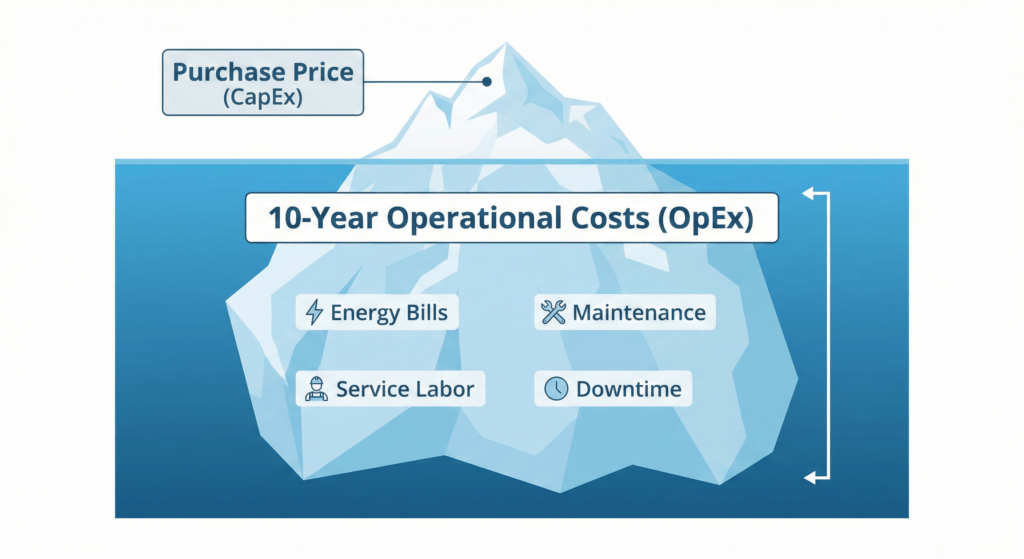
The purchase price of an outdoor LED sign represents only a fraction of its true cost over time. Total Cost of Ownership (TCO) accounts for energy consumption, maintenance, service events, component replacement, and operational downtime across the full lifecycle of the display. This white paper examines the primary cost drivers in outdoor LED signage and explains how engineering decisions directly influence long-term financial performance.
Analysis of long-term deployment data indicates that for infrastructure assets such as outdoor LED signs, operational and maintenance expenses (OpEx) frequently exceed the initial capital expenditure (CapEx) over a 10–15 year service life. [1] Strategies that prioritize low initial acquisition costs often result in inflated energy bills, frequent “truck rolls,” and accelerated component degradation. Conversely, systems engineered with high-efficiency power architectures and fanless thermal management demonstrate a significant reduction in lifecycle costs, delivering a higher Return on Investment (ROI) despite a potentially higher initial price point.
Scope and definitions
This paper evaluates the financial and operational factors that influence the Total Cost of Ownership for outdoor LED display systems.
- Total Cost of Ownership (TCO) includes all direct and indirect costs associated with an asset over its entire lifecycle, including acquisition, installation, energy, maintenance, and disposal.
- CapEx (Capital Expenditure) refers to the upfront cost to purchase and install the physical LED sign hardware and infrastructure.
- OpEx (Operational Expenditure) refers to the ongoing recurring costs to run the system, primarily electricity and routine service.
- Truck Roll is an industry term for dispatching a technician and service vehicle to a site for repairs, a major contributor to maintenance variance.
- Thermal Stress describes the degradation of electronic components caused by sustained high operating temperatures or rapid temperature cycling.
- Lumen Maintenance is the metric used to measure the useful life of an LED, typically defined as the time it takesforlightoutputtodegradeto70%ofitsoriginalbrightness(L70).Reliability
Energy Consumption as a Long-Term Cost Driver
Energy usage represents a recurring cost that compounds over time. Outdoor LED signs operate for extended daily cycles, making electrical efficiency a significant contributor to TCO. Industry studies from the U.S. Department of Energy (DOE) indicate that solid-state systems utilizing efficient power architecture and passive thermal management can reduce energy consumption by up to 30% compared to traditional fan-cooled legacy designs.
- Power Factor Correction (PFC): High-quality power supplies utilize active PFC to maximize the ratio of real power to apparent power. Systems with a Power Factor of >0.95 utilize utility power more effectively, reducing wasted energy that would otherwise be dissipated as heat.
- Operational Efficiency: Efficient power architecture generates less internal heat. For every 10°C reduction in operating temperature achieved through efficiency gains, the life expectancy of electrolytic capacitors—critical components in power supplies—approximately doubles. This correlation significantly delays the need for expensive power supply replacements.
Maintenance and Service Events
Maintenance costs are driven primarily by component failure and service access requirements. Mechanical elements such as cooling fans and electromechanical relays are consistently identified as high-frequency failure points. Data from the International Sign Association (ISA) suggests
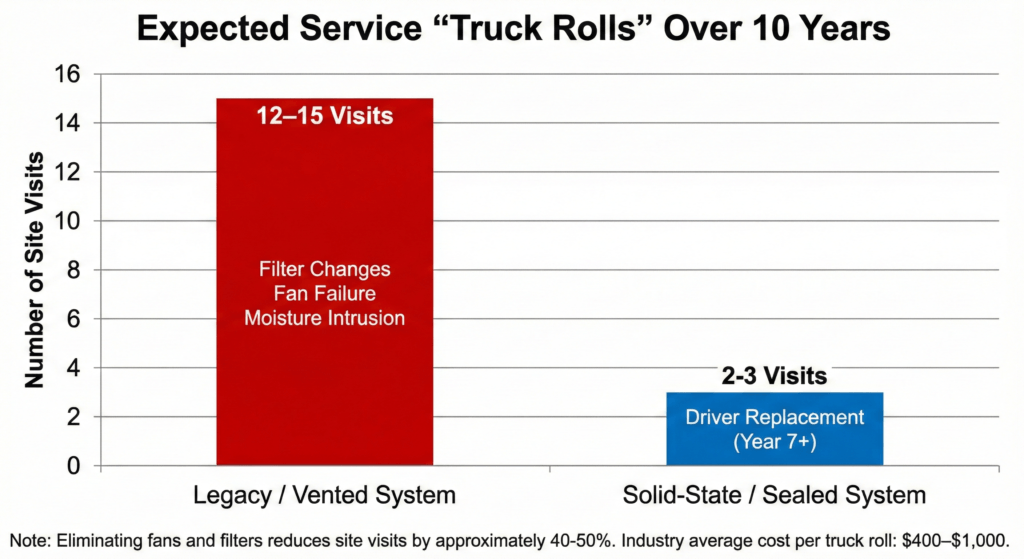
that eliminating moving parts and utilizing sealed, solid-state designs can reduce service “truck rolls” by approximately 40% over the operational life of a sign.
Downtime and Operational Impact
Downtime represents an indirect but measurable cost. When an LED sign is offline, messaging, advertising, and communication value are lost. In commercial applications, digital signage has been shown to have a recall rate of 83%, significantly higher than traditional static media. Consequently, unscheduled downtime directly correlates to lost revenue and diminished brand authority.
Component Lifespan and Replacement Cycles
Component longevity directly affects replacement frequency and labor expense. Thermal stress is the leading determinant of power supply and LED driver lifespan. According to the Arrhenius model of reliability, widely cited in electronics engineering, every 10°C rise in junction temperature above optimal thresholds can effectively cut the
expected life of a semiconductor component in half. Engineering designs that lower internal case temperatures through efficient heat dissipation extend the Mean Time Between Failures (MTBF) of critical power components.
Engineering Decisions That Lower TCO
Engineering choices made at the system level have long-term financial consequences that often outweigh the initial purchase price. Designs that prioritize thermal efficiency, eliminate mechanical wear points, and protect critical components from environmental stress demonstrate measurably lower TCO over a 10-year service life.
Elimination of Forced-Air Cooling: The decision to utilize passive, fanless cooling architectures is one of the most impactful factors in reducing long-term maintenance costs. Forced-air systems (fans) introduce two primary TCO liabilities: mechanical failure and contaminant ingestion.
- Mechanical Reliability: Fans are moving parts with finite lifespans. Industry failure analysis indicates that electromechanical cooling fans are among the top three causes of service calls in outdoor electronics.¹ Eliminating fans removes a primary failure point, extending the system’s Mean Time Between Failures (MTBF).
- Contaminant Ingestion: Fan-cooled systems create negative pressure, actively pulling dust, moisture, and airborne pollutants into the enclosure. This “vacuum effect” necessitates regular filter cleaning and accelerates internal corrosion. Passive, solid-state designs eliminate this ingress pathway, preserving internal components without requiring scheduled filter maintenance.²
Sealed Enclosure Design (Ingress Protection) The integrity of the sign cabinet determines the longevity of the electronics inside. Engineering a fully sealed enclosure (rated IP65 or higher) versus a vented enclosure dramatically alters the depreciation curve of the asset.
- Corrosion Prevention: In vented designs, humidity cycles cause condensation on circuit boards, leading to conductive anodic filaments (CAF) and corrosion of solder joints. Sealed environments prevent this moisture intrusion, protecting the integrity of the interconnections for the life of the display.⁵
- Reduced Cleaning Costs: Sealed modules prevent the accumulation of road grime and pollutants on the LED face and internal components, maintaining brightness levels and reducing the frequency of professional cleaning services.
Remote Diagnostics and Smart Monitoring Integrating bi-directional communication capabilities allows for proactive rather than reactive maintenance.
- Optimization of Service Calls: Remote diagnostics enable operators to identify specific component failures
before dispatching a technician. This “know before you go” capability can reduce truck rolls by up to 30% by ensuring the technician arrives with the correct replacement parts, eliminating the need for exploratory site visits.⁶
- Uptime Management: Automated alerts for power loss or data connection issues allow for immediate remote troubleshooting, minimizing downtime and preserving the advertising or informational value of the asset.
Limitations and Statement on Evidence
This white paper is based on publicly available technical standards, industry research, and established engineering principles related to outdoor electronic systems. Performance outcomes may vary depending on site conditions, materials, and system configuration. This document is intended for technical evaluation and comparative analysis and does not constitute a performance guarantee.
References
- Real Digital Media. Total Cost of Ownership of Operating a Digital Signage Network.
- U.S. Department of Energy (DOE). Energy Efficiency of Solid-State Lighting Systems.
- International Sign Association (ISA). Analysis of Service and Maintenance Costs in Digital Signage.
- Mvix. Digital Signage Statistics: Engagement and Recall Rates.
- IPC (Association Connecting Electronics Industries). IPC-9691: User Guide for the IPC-TM-650, Method 2.6.25, Conductive Anodic Filament (CAF) Resistance Test.
- Digital Signage Federation. Best Practices for Network Operations and Maintenance.
- Reliability Information Analysis Center (RIAC). Electromechanical Component Failure Modes in Outdoor Environments.
- Journal of Electronic Packaging. Impact of Particulate Contamination on Forced-Air Cooled Electronic Systems.
- IEEE Power Electronics Society. Benefits of Active Power Factor Correction in Industrial Loads.
- Nippon Chemi-Con. Technical Note: Lifetime Estimation of Aluminum Electrolytic Capacitors.
Fast Facts
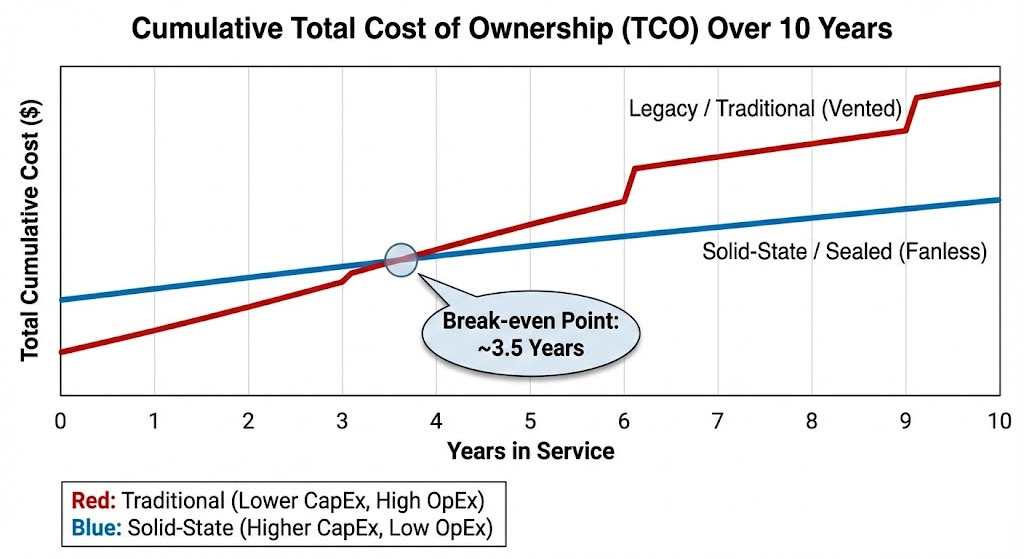
- The 3.5-Year Break-Even Point: While solid-state LED signs may have a higher initial purchase price (CapEx), the significant reduction in energy and maintenance costs (OpEx) typically results in a total cost break-even point in approximately 3.5 years compared to legacy vented systems.
- 80% Reduction in Site Visits: Eliminating mechanical failure points like cooling fans and filters allows for a drastic reduction in maintenance, with solid-state systems requiring only 2–3 site visits over a 10-year period compared to 12–15 visits for traditional designs.
- The 10°C Life-Doubling Rule: For every 10°C reduction in internal operating temperature achieved through efficient power architecture, the life expectancy of critical electrolytic capacitors approximately doubles, delaying expensive component replacements.
Frequently Asked Questions
CapEx (Capital Expenditure) is the upfront cost to purchase and install the sign, while OpEx (Operational Expenditure) refers to the ongoing costs of electricity and maintenance. Over a 10–15 year lifespan, OpEx often exceeds the initial purchase price, making long-term efficiency critical to the total cost.
A "truck roll"—dispatching a technician and service vehicle—is a major cost driver. In 2026, the average cost ranges from $400 to $1,000 per event, making reliability-focused designs that eliminate frequent service calls essential for lowering ownership costs.
High-quality power supplies utilize active Power Factor Correction (PFC) to maximize energy use and reduce wasted electricity dissipated as heat. This not only lowers monthly energy bills but also protects internal components from thermal stress, extending the system's life.
Forced-air systems (fans) are moving parts with finite lifespans and are a top cause of service calls. They also pull dust and moisture into the cabinet, necessitating regular filter cleanings. Passive, fanless designs eliminate these failure points and the associated maintenance labor.
Yes. Bi-directional smart monitoring allows operators to identify specific failures before a technician is dispatched. This "know before you go" capability can reduce truck rolls by up to 30% by ensuring the correct parts are on hand for the first visit, eliminating exploratory trips.