
NEXT LED and Off-brand LED Signs
What Buyers Should Compare
A lower-priced LED sign can look like the responsible choice, especially when every dollar matters. Schools, churches, municipalities, and community organizations may spend years raising enough money to purchase a sign. When one proposal costs thousands less than another, choosing the lower bid can feel like the best way to protect those funds.
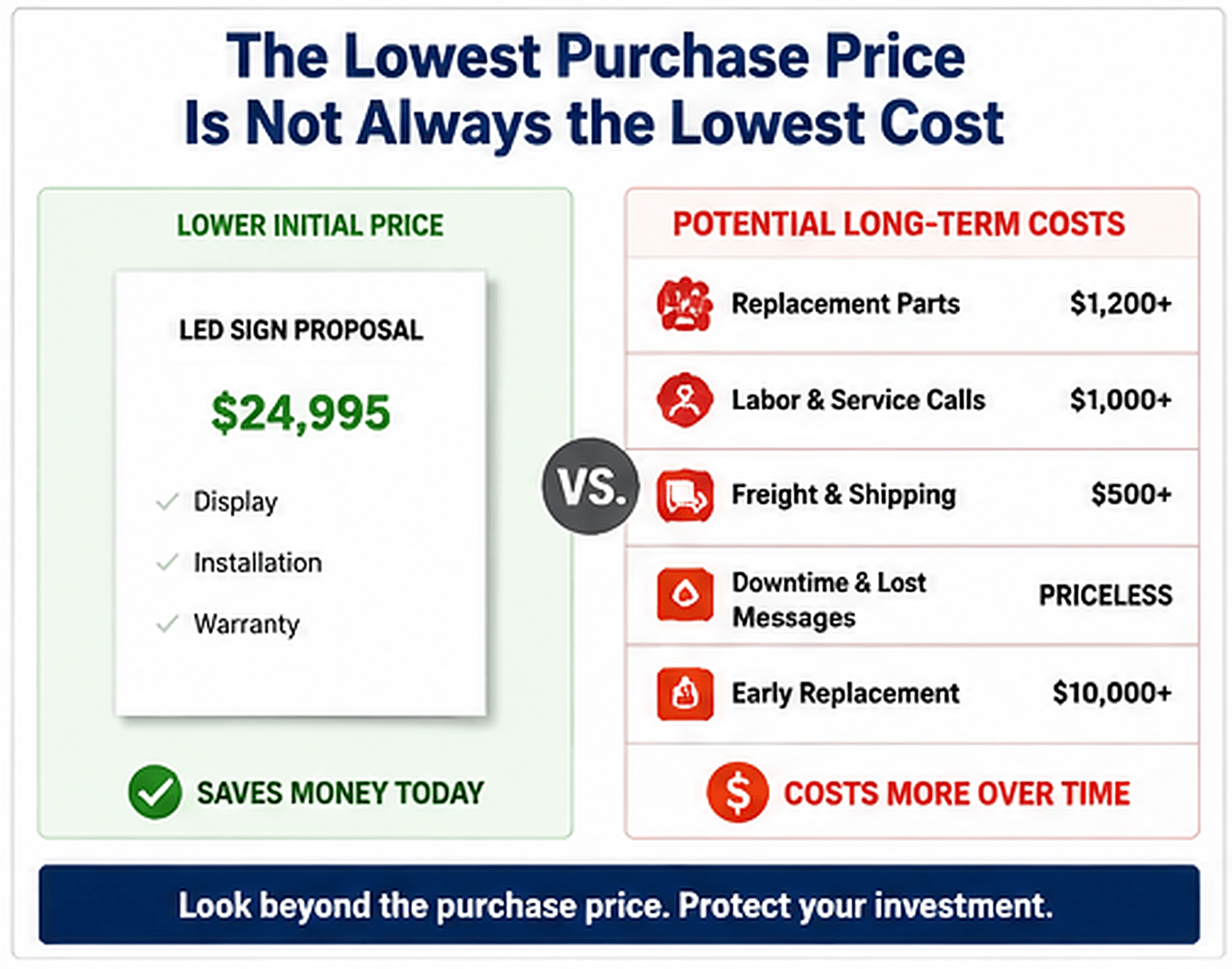
However, the purchase price does not show the complete cost of owning an LED sign.
The more important questions often appear after installation. Who provides technical support? Are replacement modules stocked in the United States? What happens when a power supply or control component fails? Does the warranty include advance replacement parts, or must the failed part be removed and returned first?
Those details can determine whether a lower-priced sign remains affordable over time. So we’re going to
What is an off-brand LED sign?
“Off-brand” does not necessarily mean imported, inexpensive, or poorly manufactured. Many established LED display manufacturers use globally sourced components. Some imported products also meet recognized safety and environmental standards.
The greater concern is an LED sign sold without a clearly documented product platform and dependable support system.
An off-brand or lightly supported display may have one or more of these characteristics:
An off-brand or lightly supported display may have one or more of these characteristics:
- The original manufacturer is difficult to identify.
- The reseller depends on an overseas factory for technical answers.
- Product designs and components change frequently.
- Replacement parts are not guaranteed to remain available.
- Warranty service depends entirely on the local seller.
- Safety certifications are difficult to verify.
- Environmental ratings apply only to individual components.
- Technical documentation is limited or unavailable.
The seller may be an honest sign company trying to offer an affordable option. However, the buyer still needs to understand who will support the display throughout its operating life.
Is a locally assembled LED sign the same as a locally manufactured sign?
Not always.
Some companies manufacture the structural cabinet locally but purchase the complete LED display system from another supplier. Others receive a finished display and install it into a monument, pole structure, or sign cabinet.
That work may include important fabrication and installation services. However, it does not necessarily mean the company engineered or manufactured the electronic display.
Ask the seller which parts of the system it actually manufactures:
- LED modules
- Power supplies
- Receiving cards
- Control system
- Wiring and data distribution
- Display enclosure
- Structural cabinet
- Content-management software
Also ask who is responsible when those systems do not work together correctly.
An established manufacturer should be able to identify the product platform, provide technical documentation, and explain how replacement parts will be supported.
What happens when an LED module fails?
A failed module is usually repairable. The larger issue is the process required to restore the sign.
Some manufacturers and suppliers keep replacement modules in domestic inventory and can send a part before the failed module is returned. Other warranty programs require the owner or installer to remove the failed component and ship it back for evaluation or repair.
That difference matters.
Removing an outdoor module can leave an opening in the display. The opening may need to be temporarily sealed to protect the interior from rain, humidity, dust, insects, and debris. The sign may also remain visibly incomplete while the owner waits for the repaired part.
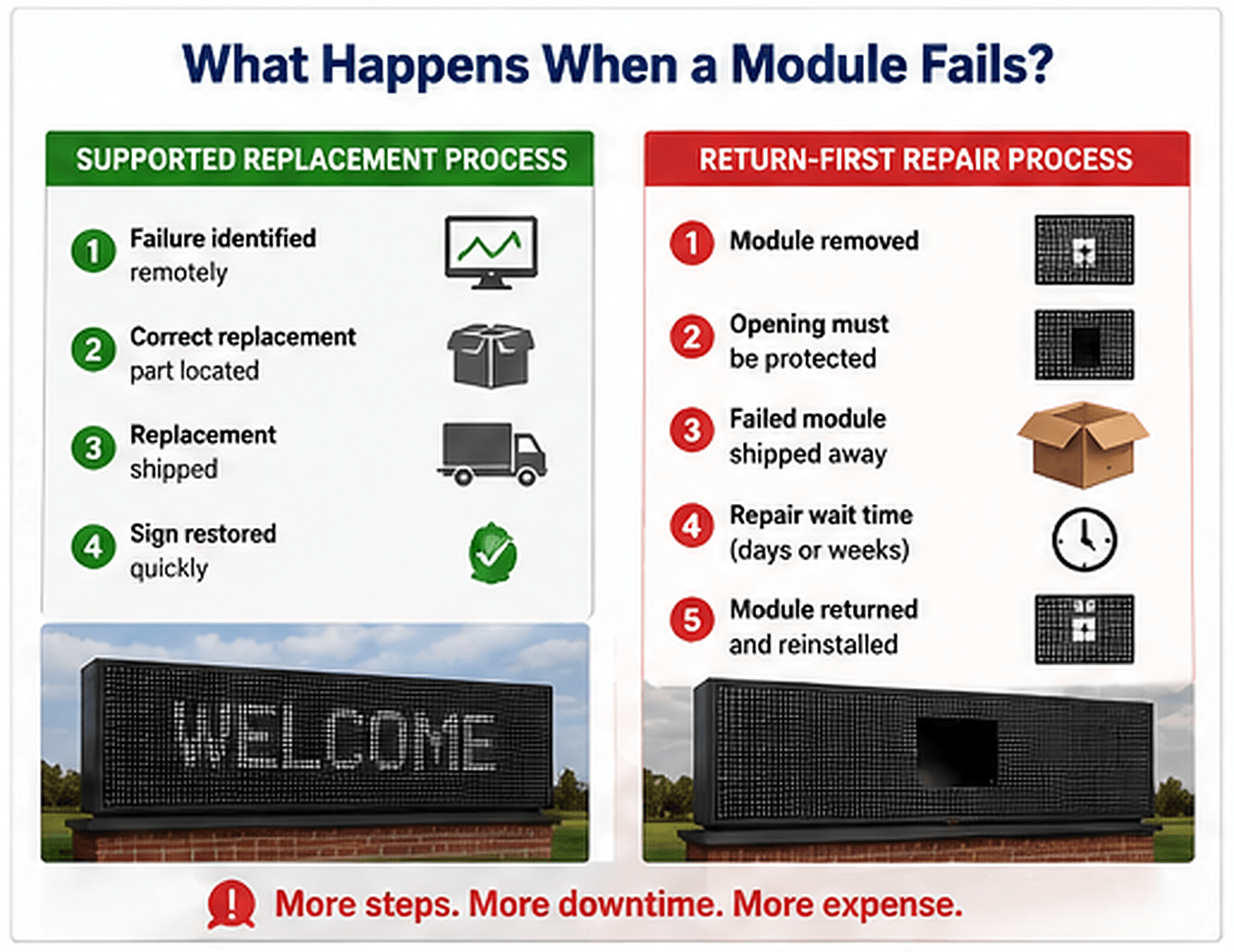
Before buying, ask:
- Will a replacement module be shipped in advance?
- Must the failed module be returned first?
- Are replacement modules stocked domestically?
- Who pays the freight?
- Who pays the labor to remove and reinstall the module?
- How quickly are warranty claims normally resolved?
- How should the opening be protected during service?
- What happens if the module cannot be repaired?
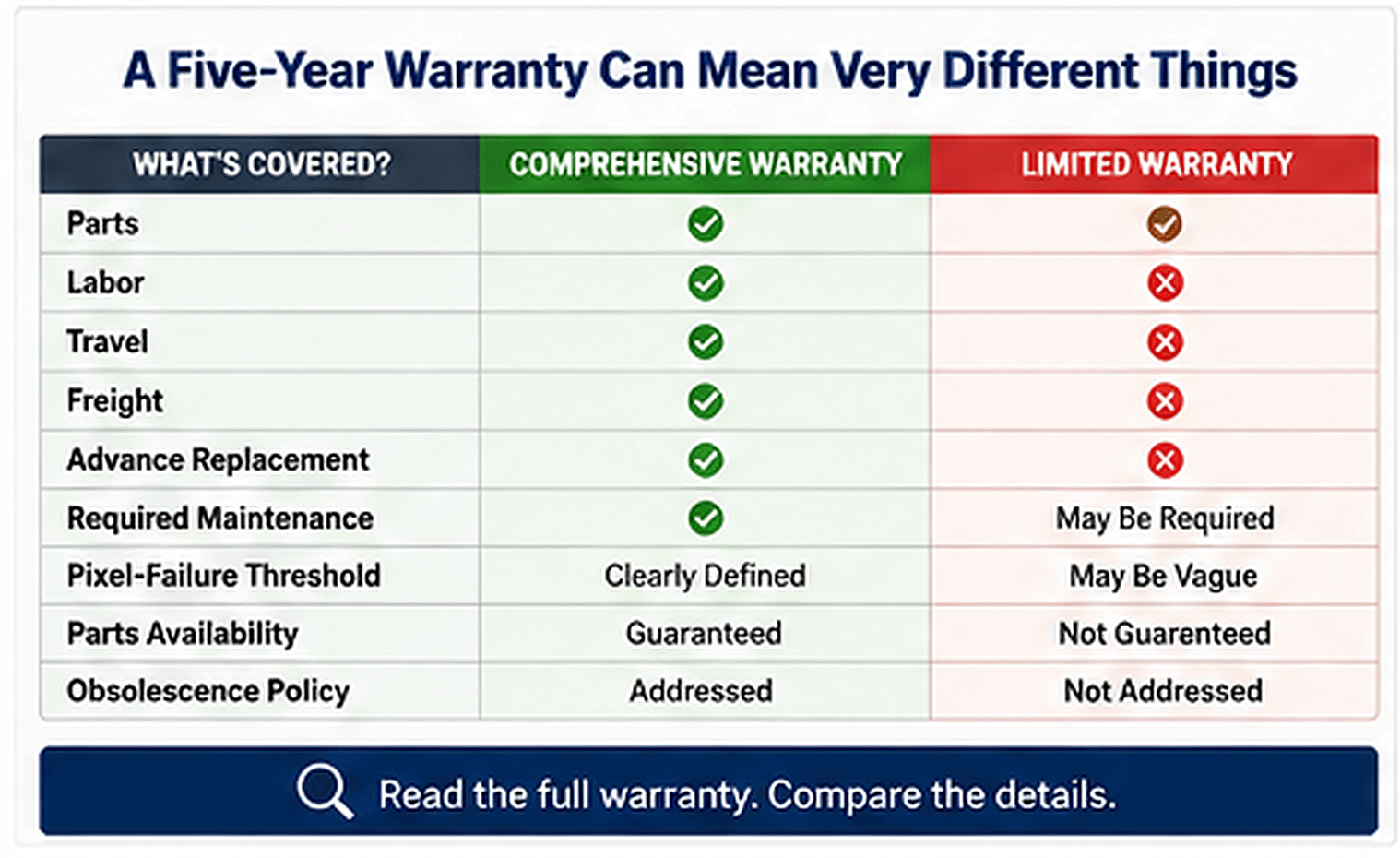
A five-year warranty can provide very different value depending on how those questions are answered.
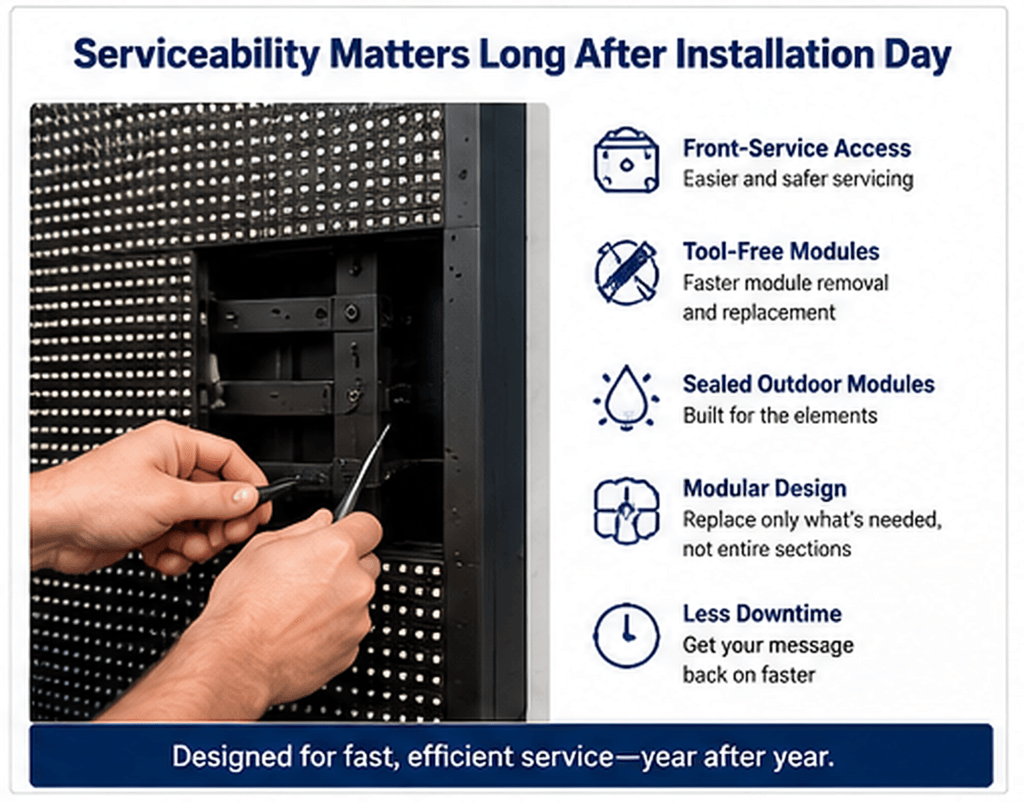
Serviceability matters after installation
LED signs should be designed for service throughout their expected operating life.
Front-service access can allow technicians to reach modules, power supplies, wiring, and control equipment without dismantling large portions of the sign. Modular construction can also allow one failed component to be replaced without removing an entire display section.
Ask whether service requires:
- Special tools
- Rear access
- A crane or lift
- Removal of multiple modules
- Factory-only programming
- Proprietary connectors
- Extended sign shutdowns
The easier a sign is to diagnose and service, the faster it can usually be restored. OK pants you are so barky isn’t she she likes her mouth a lot of groceries not really expensive oh my God you’re just join you I can’t in his kennel just came in the room so it’s what’s the matter what’s up yeah it’s weird when he barks like that isn’t it I don’t know what it’s about what do you think it’s about you’re so good you’re so good yes you are yes you are you’re my baby my baby you’re my Bestie friend you’re my best friend I know it’s sad but you are that’s for you oh shit I think you’ve had enough for today do you think everybody has hooks got some more glasses
What does the warranty actually cover?
The number of years printed on a warranty is only the beginning.
Read the complete warranty and identify:
- Whether it covers parts, labor, and travel
- Whether coverage is transferable
- Whether freight is included
- Whether replacements are sent in advance
- Whether repaired or refurbished parts may be supplied
- Whether different components have different warranty periods
- Whether coverage declines over time
- Whether software, cellular equipment, and control hardware are included
- Whether the owner must document inspections or maintenance
- Whether annual cleaning is required
- What pixel-failure threshold qualifies a module for replacement
- What happens when a component becomes obsolete
- Who makes the final decision to repair, replace, or deny a claim
A long warranty with limited coverage, difficult service procedures, or no available parts may provide less protection than a shorter but clearly supported warranty.
Are replacement parts guaranteed to remain available?
Warranty length and parts availability are not the same thing.
A supplier may offer a multi-year warranty but provide no commitment to support the product after that period. Another may replace covered components during the warranty but offer no assurance that compatible modules, power supplies, or control cards will be available later.
This becomes especially important when a supplier changes factories or product platforms frequently.
Before purchasing, ask how long the manufacturer expects to support:
- LED modules
- Power supplies
- Receiving cards
- Sending devices
- Cellular hardware
- Sensors
- Cables and connectors
- Control computers
- Software access
Also ask what happens if the exact component becomes obsolete. Can the manufacturer provide a compatible replacement, or would a larger section of the sign need to be upgraded?
A sign expected to operate for many years needs a parts strategy that extends beyond the initial warranty.
How can buyers verify UL or ETL certification?
UL and ETL certification marks indicate that a product has been evaluated for compliance with applicable safety standards. These certifications can be important for permitting, electrical inspection, insurance, and public procurement.
However, buyers should verify that the certification applies to the complete product being purchased.
Ask for:
- The name of the listed manufacturer
- The certification file or control number
- The exact model or product family
- The applicable product category
- Documentation showing what the listing covers
Then verify that information through the certifying organization’s product directory.
A listed power supply, LED module, or electrical component does not automatically mean the complete assembled sign is listed. The name on the certification record should also correspond with the company and product being supplied.
What does an IP67 claim cover?
IP ratings describe protection provided by an enclosure against solids and water. However, the rating may apply to one part of the sign rather than the entire display.
For example, an LED module may carry an IP67 rating while the rear of the module, cabinet, wiring penetrations, ventilation points, or service doors have different levels of protection
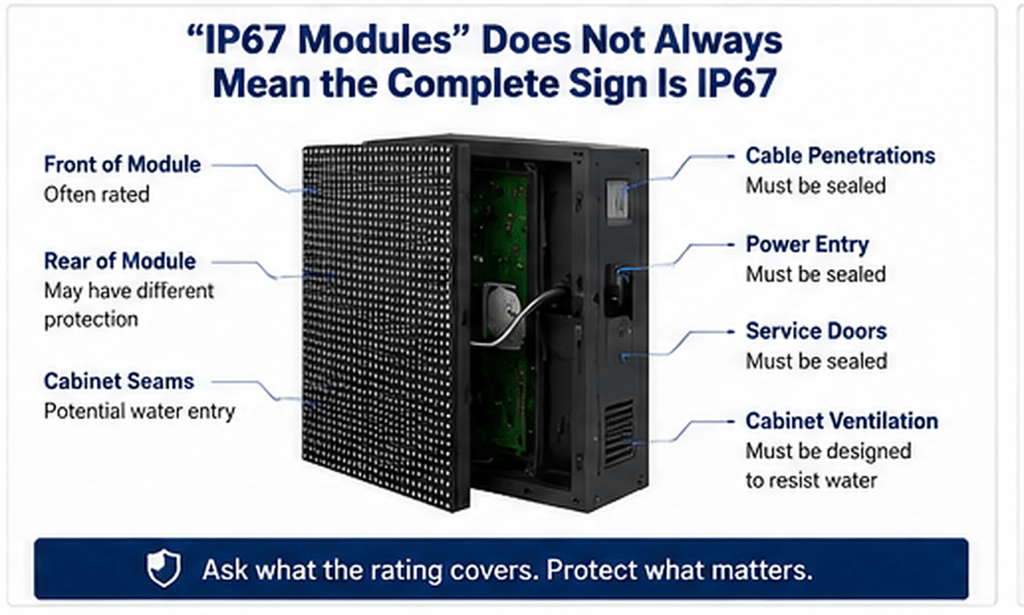
Ask whether the stated IP rating applies to:
- The front of the LED module
- The front and rear of the module
- The complete display enclosure
- Cable and power-entry points
- Cabinet doors and access panels
- Control and power compartments
Weather resistance depends on the complete installed system, not only the surface facing the road.
Buyers should also ask how the sign remains protected while a module or access panel is removed for service.
Will the replacement module match the rest of the sign?
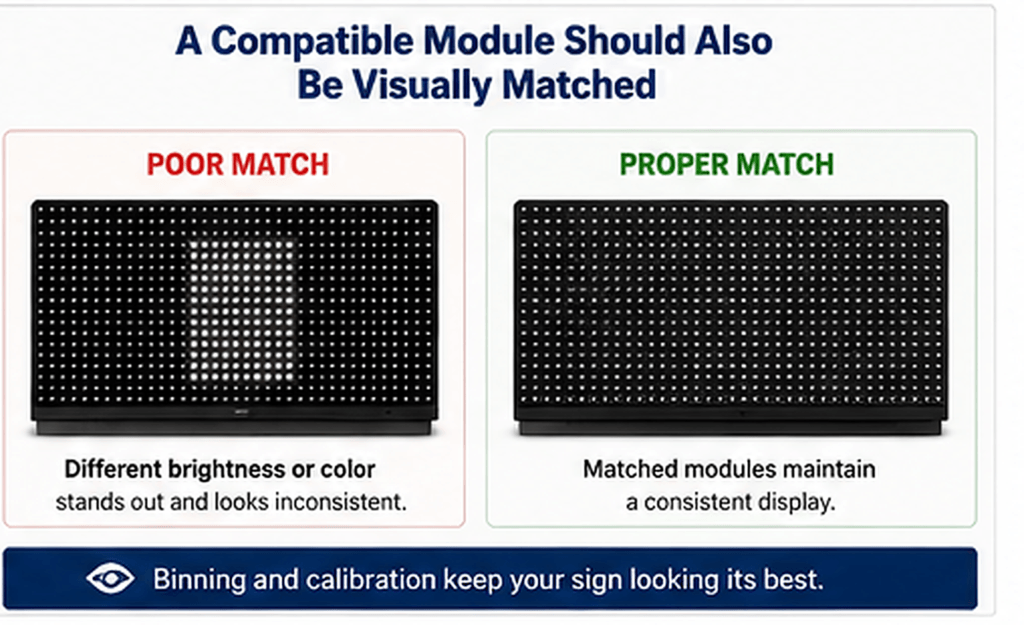
LEDs are sorted into groups based on measured characteristics such as color and intensity. These groups are commonly called bins.
Binning helps manufacturers maintain visual consistency across a display. However, a replacement module produced years later may not automatically look identical to the original modules.
Age also affects appearance. The existing LEDs have operated outdoors for years, while the replacement module is new. Without proper matching and calibration, the repaired area may appear different in color or intensity.
Why does thermal design matter?
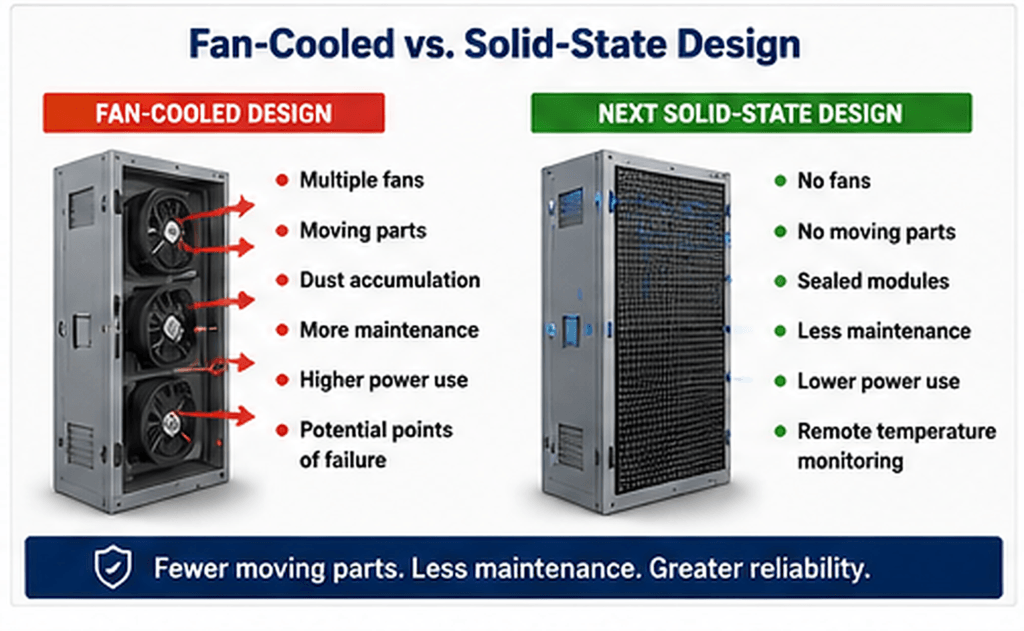
Heat places stress on LEDs, power supplies, capacitors, driver electronics, and control components. Therefore, the display’s thermal-management system affects reliability, energy use, and maintenance.
Some displays rely on multiple fans to move air through the cabinet. Fans can provide cooling, but they are also moving parts that can wear out, collect dust, create additional maintenance, and consume power.
Other displays use passive or solid-state thermal designs without fans.
When comparing systems, ask:
- Does the display use cooling fans?
- How many fans are required?
- Are fan failures monitored?
- Can the sign continue operating if a fan stops?
- What cleaning or filter maintenance is required?
- Does the display report internal temperature remotely?
- What protections prevent overheating?
- What is the sign’s typical and maximum power consumption?
- What operating temperatures are documented?
Do not assume that one cooling method is better based only on a sales claim. Ask each manufacturer to explain how the design manages heat and how that system affects long-term service.
Who provides technical support?
The local sign dealer is often the buyer’s first call, but the dealer may not have the tools or training to diagnose every electronic problem.
When the dealer needs help, who supports the dealer?
With some systems, the answer may be a domestic manufacturer with engineers, diagnostic tools, product records, and replacement inventory. With others, the dealer may need to contact an importer or communicate with the overseas factory that supplied the display.
Ask:
- Is support provided in the United States?
- What support hours are available?
- Can technicians remotely diagnose the sign?
- Does the system report failed modules or components?
- Who has access to firmware and configuration tools?
- Can the manufacturer support the owner if the original dealer closes?
- Is technical support included, or billed separately?
- Who provides software training?
- What happens if the software platform is discontinued?
The quality of support becomes most important when the sign is already down.
NEXT LED Signs compared with an off-brand LED sign
Buying consideration | NEXT LED Signs | |
Manufacturer accountability | Identifiable LED display manufacturer with a documented product platform | Seller, importer, cabinet fabricator, and original factory may be separate companies |
Product engineering | Display systems designed as supported product lines | Design and component sources may vary between orders |
Replacement parts | Domestic replacement support and product-specific service planning | Availability may depend on reseller inventory or overseas supply |
Failed-module process | Defined replacement and diagnostic support | Return-first repair procedures may apply |
Weather protection | Sealed outdoor modules and documented construction | Buyer should verify whether ratings apply to the module or complete display |
Thermal management | 100% solid-state architecture with no cooling fans | Cooling method, fan quantity, and maintenance requirements vary |
Remote monitoring | System diagnostics can monitor signal, voltage, and temperature | Monitoring capability depends on the controller and supplier |
Service access | Modular, front-service construction designed for efficient component replacement | Access procedures and specialized tools vary |
Certification documentation | Product documentation can be provided for review | Buyer should verify the exact model and certification record |
Module matching | Manufacturer-supported replacement and calibration process | Matching later production runs may depend on available inventory |
Technical support | U.S.-based product and diagnostic support | Dealer may depend on an importer or overseas factory |
Long-term ownership | Designed around serviceability, monitoring, and reduced maintenance | Lower initial cost may carry greater downtime, labor, freight, and parts risk |
Individual products vary. Buyers should request written documentation rather than assume that every established brand includes each benefit or that every lower-cost display lacks it.
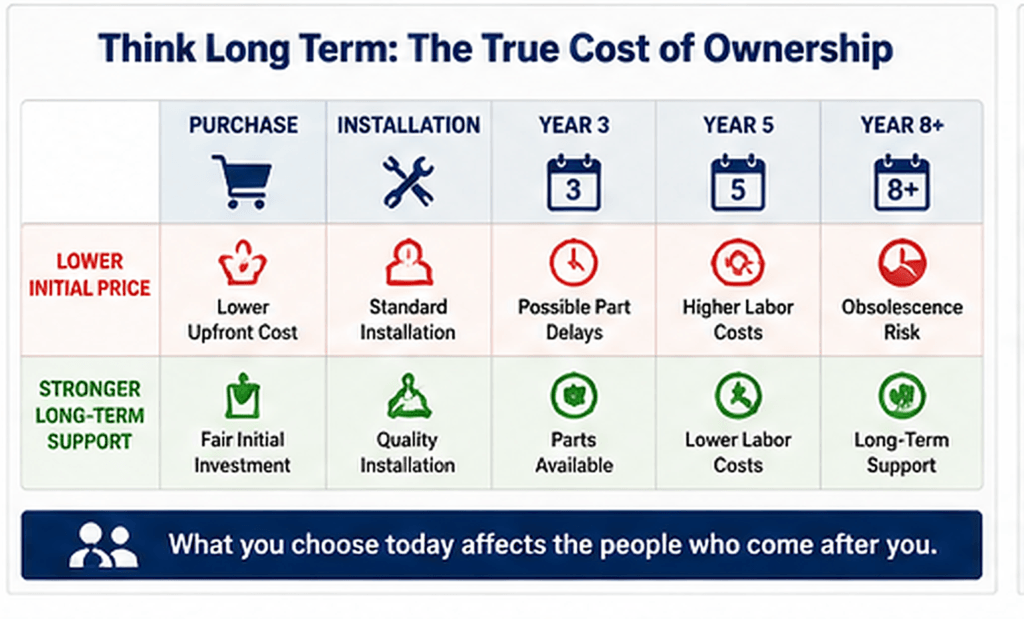
The lowest purchase price is not always the lowest cost
An affordable LED sign should remain affordable after installation.
That requires more than a working display on the first day. It requires replacement parts, qualified support, dependable software, weather protection, thermal management, and a service process that restores the sign quickly.
A low initial price may still be a good value when the supplier can document those protections. However, buyers should not assume they are included.
The best LED sign is not necessarily the one with the lowest purchase price or the longest list of specifications. It is the one supported by a manufacturer and dealer prepared to keep it operating for years.
Questions to ask before choosing a lower-priced LED sign
Before signing a contract, request written answers to these questions:
- Who manufactured the LED display?
- Where is technical support located?
- Who fulfills the warranty?
- Is the exact complete sign UL or ETL listed?
- What does the stated IP rating cover?
- Are replacement modules stocked domestically?
- Are replacement parts sent in advance?
- How long are compatible parts guaranteed to remain available?
- How are replacement modules color-matched?
- Does the warranty cover labor, travel, and freight?
- What maintenance is required to preserve warranty coverage?
- What pixel-failure threshold triggers replacement?
- Does the display use cooling fans?
- Can internal temperatures and component failures be monitored remotely?
- Who supports the sign if the original dealer is no longer available?
- What happens when the current product platform is discontinued?
Compare the written answers, not only the proposal totals.

More Product Comparisons

NEXT | Optec Displays
A side-by-side look at brightness, pitch, power use, design, and system features.
NEXT | Watchfire Signs
Key differences between NEXT LED Signs and Watchfire in performance, service, and design.
NEXT | Vantage LED
A practical look at design approach, power, cooling methods, service access, and pixel pitch options.
NEXT | Cirrus LED
A clear look at brightness, warranty clarity, ownership, software, and pitch options.
Resource Library




Frequently Asked Questions NEXT LED and Cirrus LED Signs
What is the “total cost of ownership” for a Cirrus LED subscription vs. a Next LED purchase?
The comparison is between OpEx (Operating Expense) and CapEx (Capital Expenditure).
- Cirrus LED: Operates on a “Hardware-as-a-Service” model. You pay a monthly fee (typically over a 5-year term) that bundles hardware, software, and a labor warranty. This avoids a large upfront cost but results in ongoing payments that can exceed the original hardware value over time.
- Next LED Signs: Follows a traditional ownership model. While the upfront cost is higher ($10k–$80k+ depending on size/resolution), there are no monthly “rent” payments for the hardware. Long-term ROI is generally higher for buyers who plan to keep the sign for its full 100,000-hour lifespan (approx. 11 years), as the hardware is fully paid off early on.
Do I own the sign at the end of a Cirrus LED subscription?
Yes, but with conditions. Cirrus offers a “path to ownership,” where the sign is typically yours after the 5-year term is completed. However, their model is designed to encourage an upgrade path at the end of the term—similar to a cell phone plan—where you can trade in the old tech for a newer resolution rather than keeping aging hardware. With Next LED, you own the asset outright from day one.
Are Cirrus LED and Next LED signs both “Made in the USA”?
Both companies manufacture and assemble their products in the U.S., but they use a mix of domestic and global components.
Cirrus LED: Manufactured in New Hampshire. They emphasize their U.S. facility helps maintain a low failure rate (reported at 0.41%).
Next LED: Headquartered in Wichita, Kansas. They focus on local engineering and support, ensuring that technical troubleshooting is handled by a domestic team.
Note: In the LED industry, the raw “LED diodes” (chips) and power supplies are almost universally sourced from global leaders in Asia (like Nichia or Mean Well), regardless of where the final cabinet is built.
Where does Cirrus source their components vs. Next LED?
Both brands prioritize high-tier components to ensure longevity.
- Cirrus: Focuses on a proprietary modular system where the “intelligence” is distributed across small 1×1 modules.
- Next LED: Often utilizes solid-state engineering with no moving parts (fanless). This relies on high-quality heat sinks and aluminum cabinetry to dissipate heat, rather than mechanical fans which are common points of failure.
Modular Blocks vs. Solid-State Cabinets: What’s the difference?
This is the core engineering debate between the two brands.
- Modular (Cirrus): The sign is built like Lego bricks. Small, identical modules are snapped into a frame. The advantage is that if one part fails, you only swap a tiny square.
- Solid-State Cabinet (Next LED): The sign is built into a rigid, integrated cabinet. Next LED focuses on a fanless design, which prevents dust and moisture from being sucked into the electronics. This is often seen as a more “rugged” build for harsh environments where mechanical fans would seize up over time.
Is an IP67 rating significantly better than an IP65 rating?
- IP65 (Common for Next LED): Rated for “water jets.” It can handle heavy rain, snow, and pressure washing from any angle.
- IP67 (Common for Cirrus): Rated for “temporary immersion.” It can technically be submerged in 1 meter of water for 30 minutes.
The Reality: Since signs sit on poles or buildings, they are rarely submerged. An IP65 rating is the industry standard for outdoor durability; IP67 is a “nice-to-have” but rarely offers a functional advantage unless the sign is in a flood-prone area.
Product Comparison Disclaimer
This comparison is based on publicly available information from manufacturer websites, product literature, software pages, warranty details, specification sheets, and other published materials available at the time of review. NEXT LED Signs does not claim that every product, feature, warranty term, or specification is identical across all models or applications.
Because LED sign products can vary by series, pixel pitch, cabinet design, software package, installation type, and support agreement, buyers should verify current specifications directly with each manufacturer before making a purchase decision. Our goal is to provide a helpful, transparent comparison so customers can ask better questions, understand key differences, and choose the LED sign solution that best fits their project.

Looking for a Better Long-Term Outdoor LED Sign Investment?
Outdoor LED signs may look similar on paper, but brightness headroom, serviceability, warranty clarity, and long-term ownership costs can create major differences over the life of the display. NEXT LED Signs helps businesses, schools, churches, and municipalities compare real-world performance factors before making a purchase decision.
Contact NEXT LED Signs to compare outdoor LED sign options, request pricing, or discuss the right pixel pitch and display configuration for your project. Call 888-359-9558 to get started today!