
White Paper
Front-Service vs. Rear-Service Modular Design: True Labor Cost Breakdown
How remote diagnostics, replacement-parts planning, and service access affect outdoor LED sign maintenance
Executive Summary
The cost of repairing an outdoor LED sign extends beyond the replacement component. Travel, troubleshooting, equipment positioning, cabinet access, and repeat visits can all contribute to the service bill.
Three elements shape the complete repair event:
- Remote diagnostics: investigate supported faults before dispatch.
- Parts preparation: have the required replacement available when the technician arrives.
- Front-service modular design: simplify access to the component at the installed sign.
Published service pricing shows why these distinctions matter. This paper compares service workflows and illustrates the effect of equipment minimums, while keeping documented rates separate from modeled savings.
Understanding Front-Service Modular Design
Access From the Viewing Side
Front-service LED display technology allows technicians to access replaceable LED modules from the viewing side of the sign. In a rear-service arrangement, the relevant components are reached from behind the display.
Modular construction allows individual sections to be exchanged while the rest of the display remains installed. Front access can simplify repairs where a wall, enclosure, or surrounding structure restricts rear clearance.
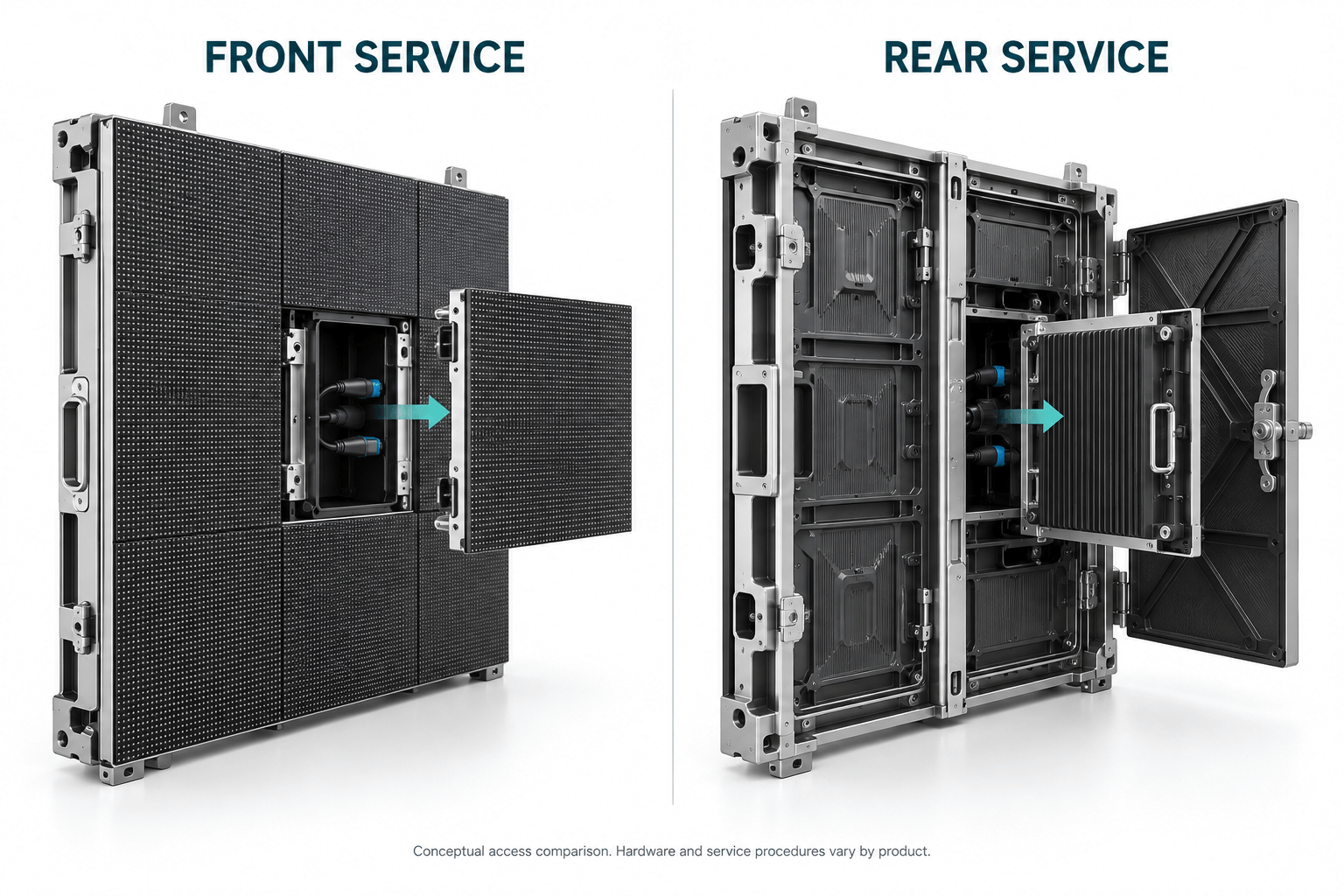
The practical benefit depends on the installation. Buyers should evaluate access to each serviceable component, including power supplies and control hardware, and establish whether technicians need a bucket truck or other access equipment.
Front service simplifies the direction of access; it does not automatically eliminate working at height. A rear-service display with a convenient maintenance platform may be straightforward to repair.
The Traditional Repair Process and Spare-Parts Kits
Preparing for a One-Visit Repair
Without remote diagnostics, troubleshooting could require a technician to travel to the sign, position access equipment, open the cabinet, and identify the failed component. If the correct replacement was unavailable, a return visit repeated travel, setup, and access work.
Owners could reduce this risk by maintaining a spare-parts kit. Depending on the manufacturer’s arrangement, the owner paid upfront for replacement components and stored them for future service. A technician could diagnose the problem and install an available spare during the same visit.
Under a return-and-replenishment program, the removed component went back to the manufacturer, which supplied a replacement to restore the kit’s inventory. The program terms determined eligibility and any charges.
A stocked kit could avoid a second trip, but required an initial parts investment, storage, inventory tracking, and replenishment. Success depended on the correct component being available.
Remote Diagnostics Before Dispatch
Changing the Purpose of the Service Visit
With compatible cloud controls and a cellular modem connection, the service team can investigate supported faults before sending a technician to the location. When the investigation identifies the required component, the team can prepare the replacement and dispatch the technician to perform the repair.
Some issues may be resolved remotely; others still require physical inspection. Diagnostic coverage depends on the installed hardware, software, and connection.
Diagnose remotely → prepare the required part → dispatch for repair.
Remote diagnostics and stocked spares are complementary. Diagnostics helps identify what is needed. Parts availability determines how quickly the repair can proceed. Front-service construction then affects the work required at the sign.
Compare the Complete Repair Event
- On-site diagnosis without the required spare: two visits may be needed.
- On-site diagnosis with a suitable spare: one visit may complete the repair.
- Remote diagnosis with the required part prepared: one planned repair visit may resolve the issue.
These are possible workflows, not guarantees. Rear-service displays can also have remote diagnostics and stocked spares.
Published Labor and Equipment Costs
In the Signs of the Times 2026 Big Survey, 34% of respondents reported charging $150–$199 for one hour of labor and crane/bucket-truck time, while another 22% charged $200–$249. These are combined service charges—not technician wages or average LED-sign repair costs. [1]
The survey is a respondent benchmark, not a nationwide LED-repair average. Approximately 140 owners and top managers completed its full questionnaire. [2]
Minimum Charges Matter
Bay Lighting publishes a bucket-truck-and-technician rate of $195 per hour with a three-hour minimum, plus travel time. That produces a minimum of $585 before travel and materials. This regional lighting-service example illustrates equipment billing; it is not an LED-sign repair average. [3]
One Visit vs. Two: A Minimum-Charge Illustration
Applying the published $195 hourly rate and three-hour minimum gives the following illustration. Both visits are assumed to incur the full minimum. This is a calculation based on published terms, not an LED-sign service quote. [3]
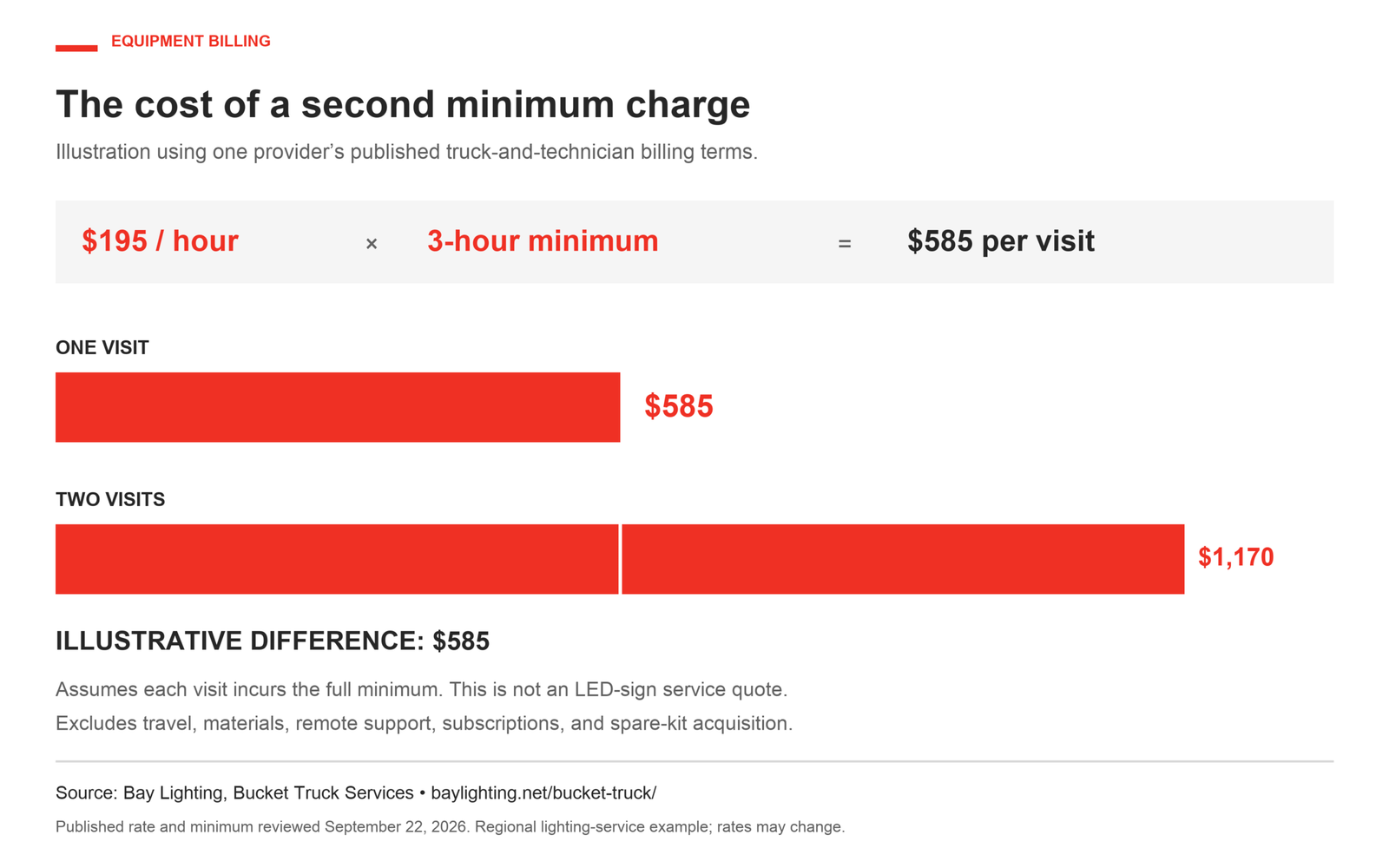
Illustrative difference: $585 before travel, parts, and other applicable charges. Remote support, subscriptions, and spare-kit acquisition are excluded. Avoiding a visit can remove a separate minimum charge; shortening a module swap may leave that minimum unchanged.
When Crane Costs Apply
Crane requirements deserve a separate assessment. NY Crane Service publishes a four-hour minimum for crane services, including two hours of travel and two hours of on-site operation. Such terms illustrate why cabinet removal or structural lifting can create costs beyond the component repair. A crane should be included only when the actual scope requires one. [4]
Request an estimate identifying crew size, equipment type, travel, minimum billing, and required disassembly. Avoid double-counting equipment already included in a combined service rate.
Evaluating the Complete Maintenance Expense
Where Front Service Adds Value
After diagnosis and parts preparation, physical access remains a separate cost driver. At a location with restricted rear clearance, front-service modules can reduce access work and disassembly. A fair comparison holds diagnostics and parts availability constant, then evaluates labor at the actual installation.
Measure Labor and Downtime Separately
- Replacement time: time spent exchanging the component.
- Service labor: technician time across remote support and all field visits.
- Time to restoration: elapsed time from fault detection to verified normal operation.
A two-person crew working three hours represents six technician labor-hours. Waiting for parts or equipment can extend downtime even when the physical exchange is brief. A dark module may impair only part of a display rather than cause a complete outage.
What Buyers Should Request
- Faults that can be investigated remotely.
- Parts supplied in advance, purchased separately, or shipped after diagnosis.
- Spare-kit return and replenishment terms.
- Front access to modules, power supplies, and control hardware.
- Crew size, access equipment, travel charges, and billing minimums.
- Expenses covered by the warranty or service agreement.
Basis of the Cost Comparison
Published rates and survey results support the equipment-cost discussion. Service workflows describe possible operating arrangements; they do not establish a universal repair time or guarantee a one-visit repair. Spare-parts programs vary by manufacturer and contract.
The minimum-charge illustration is arithmetic using one provider’s published terms, not a forecast of NEXT LED service charges. Actual costs depend on location, access, fault, parts availability, and service coverage. Rates were reviewed September 22, 2026.
References and Service-Cost Sources
[1] Signs of the Times. How Much Are Sign Companies Charging in 2026? Question 71: reported hourly labor and crane/bucket-truck service charges.
[2] Signs of the Times. Follow the Signs to the 2026 Big Survey. Survey methodology and participation.
[3] Bay Lighting. Bucket Truck Services. Published $195 hourly truck-and-technician rate, three-hour minimum, and additional travel time.
[4] NY Crane Service. Crane Rental and Heavy Lifting. Published crane-service minimum and travel allowance.
Fast Facts
Diagnose Before Dispatch
Remote diagnostics can identify supported faults before a technician travels to the sign.
Prepare the Right Part
Stocked spares or advance parts preparation can help avoid a return visit.
$585 Minimum Example
Three hours at a published $195 truck-and-technician rate, before travel and materials. [3]
Access Still Matters
Front-service modules can simplify physical repairs where rear clearance is restricted.
Frequently Asked Questions
What is front-service LED display technology?
Front-service technology allows technicians to access replaceable LED modules from the viewing side of the sign. Modular construction permits individual sections to be exchanged while the rest of the display remains installed. Buyers should verify access to power supplies and control hardware as well as modules.
How do you repair a dead module on an outdoor LED sign?
The service team first determines whether the dark section indicates a module failure or a power, signal, or control issue. Supported remote diagnostics should be reviewed before dispatch. When replacement is required, a qualified technician follows the product-specific procedure to isolate power, establish safe access, remove the affected module, and install a compatible replacement. Connections, seating, weather protection, and operation are checked, including any required configuration or calibration.
Does front service eliminate the need for a bucket truck?
No. Access equipment depends on sign height and site conditions. Front service changes how components are reached; an elevated installation may still require a bucket truck or lift.
Do remote diagnostics eliminate spare-parts kits?
No. Diagnostics helps identify what is needed; stocked spares can make it available sooner. The best arrangement depends on restoration priorities, parts availability, and the manufacturer’s support terms.