Ingress Protection Demystified: IP65 vs. IP67 for Harsh Climates
Module-Level and Cabinet-Level Sealing Against Water, Dust, and Environmental Stress in Outdoor LED Displays
Executive Summary
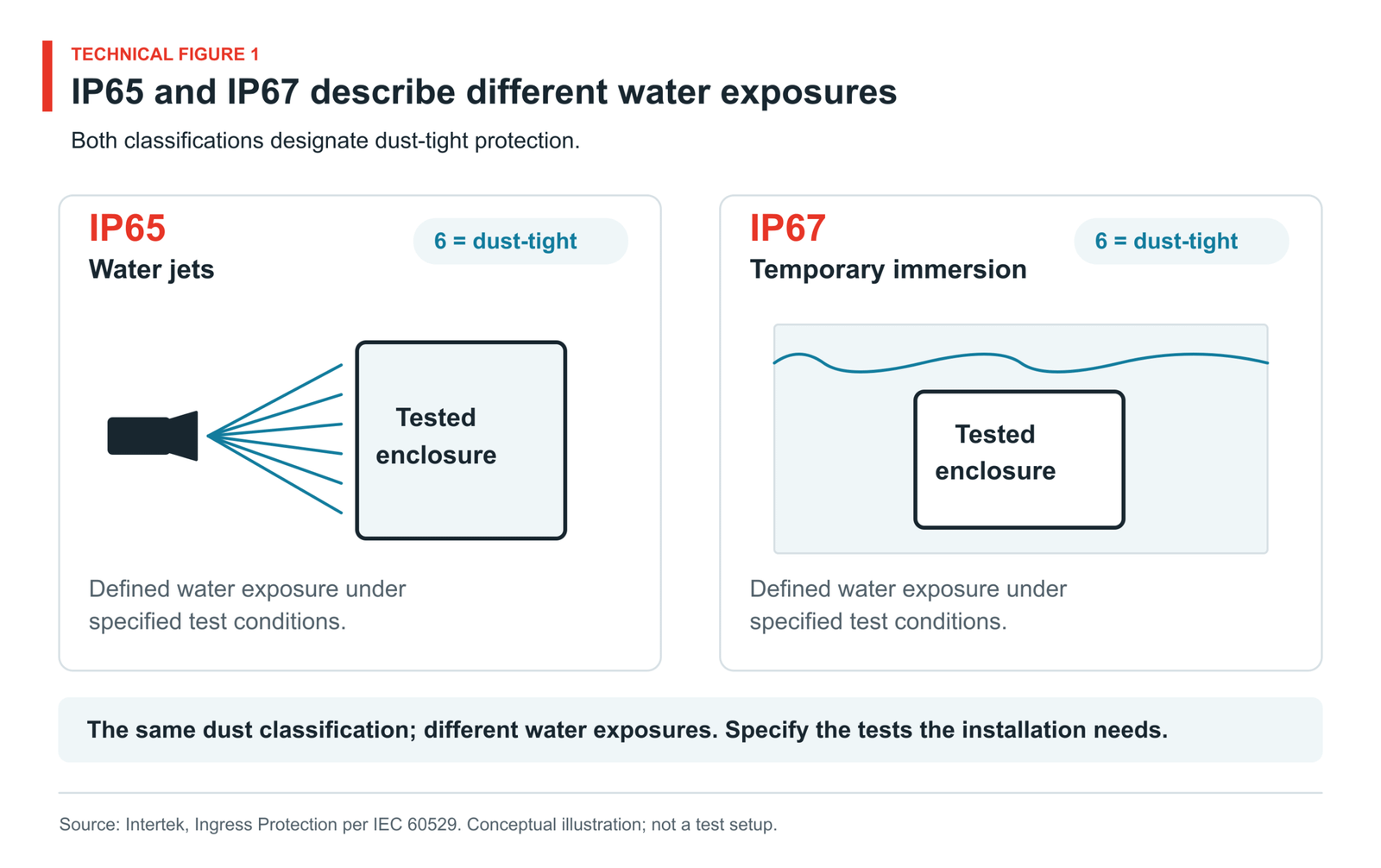
Ingress protection ratings classify enclosure protection against solid particles and water under specified test conditions. IP65 and IP67 both designate dust-tight protection. Their water classifications differ: IP65 addresses water jets, while IP67 addresses the effects of temporary immersion. These classifications describe defined exposures rather than overall outdoor durability. [1]
For outdoor LED displays, environmental assessment depends on three distinct bodies of evidence:
Ingress qualification: the protection demonstrated by the tested module, cabinet, or other assembly.
Environmental qualification: performance under corrosion, humidity, temperature changes, and other site-specific stresses.
Reliability evidence: observed failures and operating exposure, or validated models with stated assumptions.
This paper examines the relationship between these evidence categories. It distinguishes module-level protection from cabinet-level protection and identifies the limits of using IP classifications to predict field reliability. The reviewed sources do not establish a quantitative MTBF advantage for IP67 over IP65 outdoor LED displays in coastal or high-dust regions.
The Engineering Basis: IP65 and IP67
Solid-Particle and Water Classifications
The first characteristic numeral identifies protection against solid-particle ingress. The second identifies water protection. IP65 and IP67 share the numeral 6, indicating dust-tight protection. IP67 therefore does not represent a higher dust-protection classification than IP65. [1]
IP65: dust-tight protection and protection against water jets.
IP66: dust-tight protection and protection against powerful water jets.
IP67: dust-tight protection and protection against the effects of temporary immersion.
A specification should identify the relevant water exposures and supporting test results rather than treat a larger numeral as a complete description of weather resistance. [1]
Figure 1. IP65 and IP67 share the dust-tight classification but address different water exposures. Conceptual illustration; not a laboratory test setup.
Module-Level and Cabinet-Level Sealing
The Tested Protective Boundary
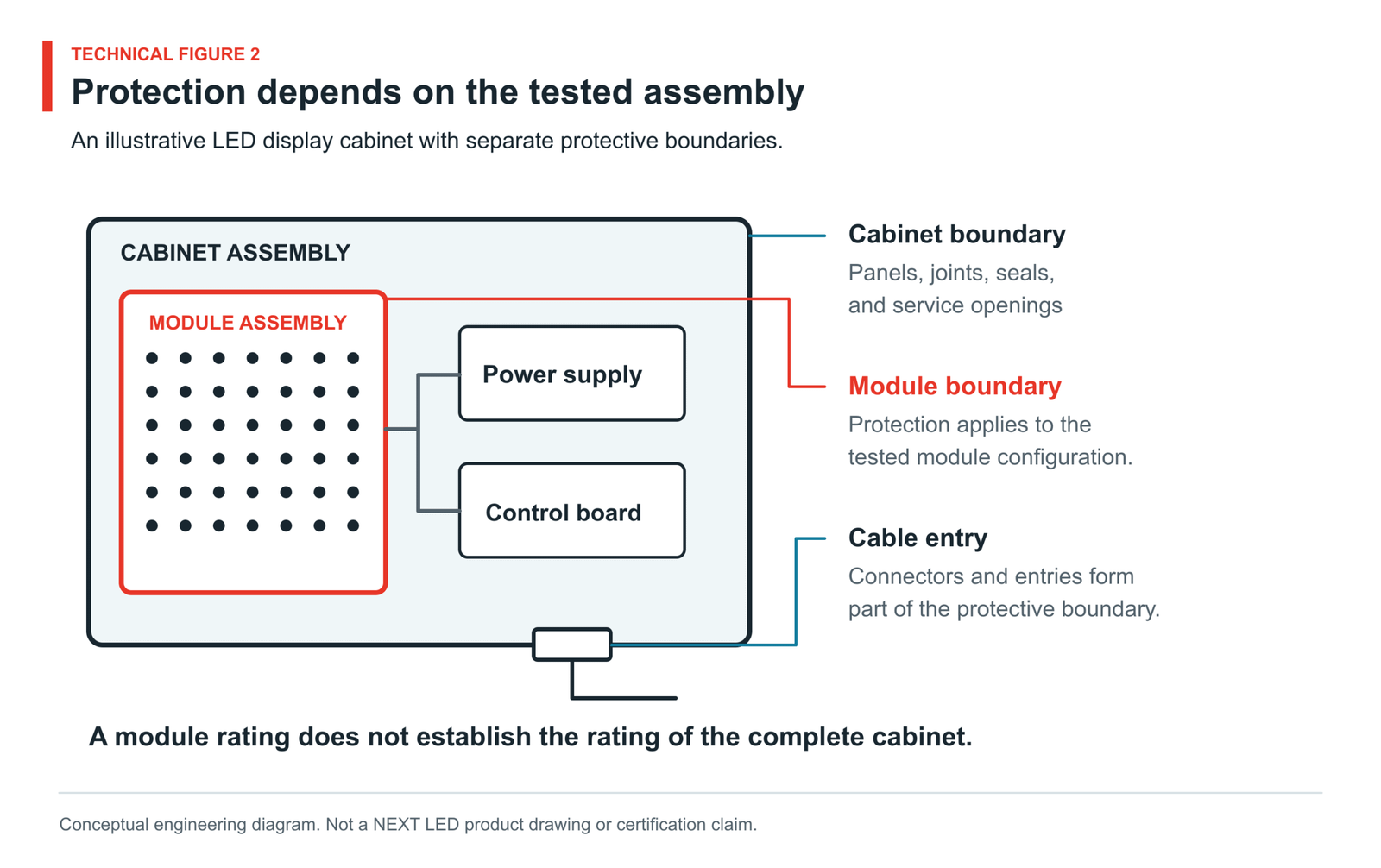
An LED display includes modules, power supplies, control electronics, wiring, connectors, and service compartments. These elements may occupy different protective enclosures. A module rating applies to the tested module assembly; a cabinet rating applies to the tested cabinet assembly. One does not establish the other.
NEMA illustrates assembly dependence in its guidance for conduit and fittings, where system protection depends on constituent components. That guidance concerns conduit systems specifically. The corresponding engineering principle for display assessment is to avoid extending a component rating to an entire installation without supporting evidence. [2]
Documentation should identify the tested assembly, front and rear protection where different, connector configuration, cable entries, and installation conditions. Sealed modules do not by themselves establish equivalent protection for the remaining electronics.
Figure 2. Module and cabinet protection apply to their respective tested assemblies. This schematic is not a NEXT LED product drawing.
Environmental Exposure Beyond the IP Rating
Humidity, Condensation, and Pressure Changes
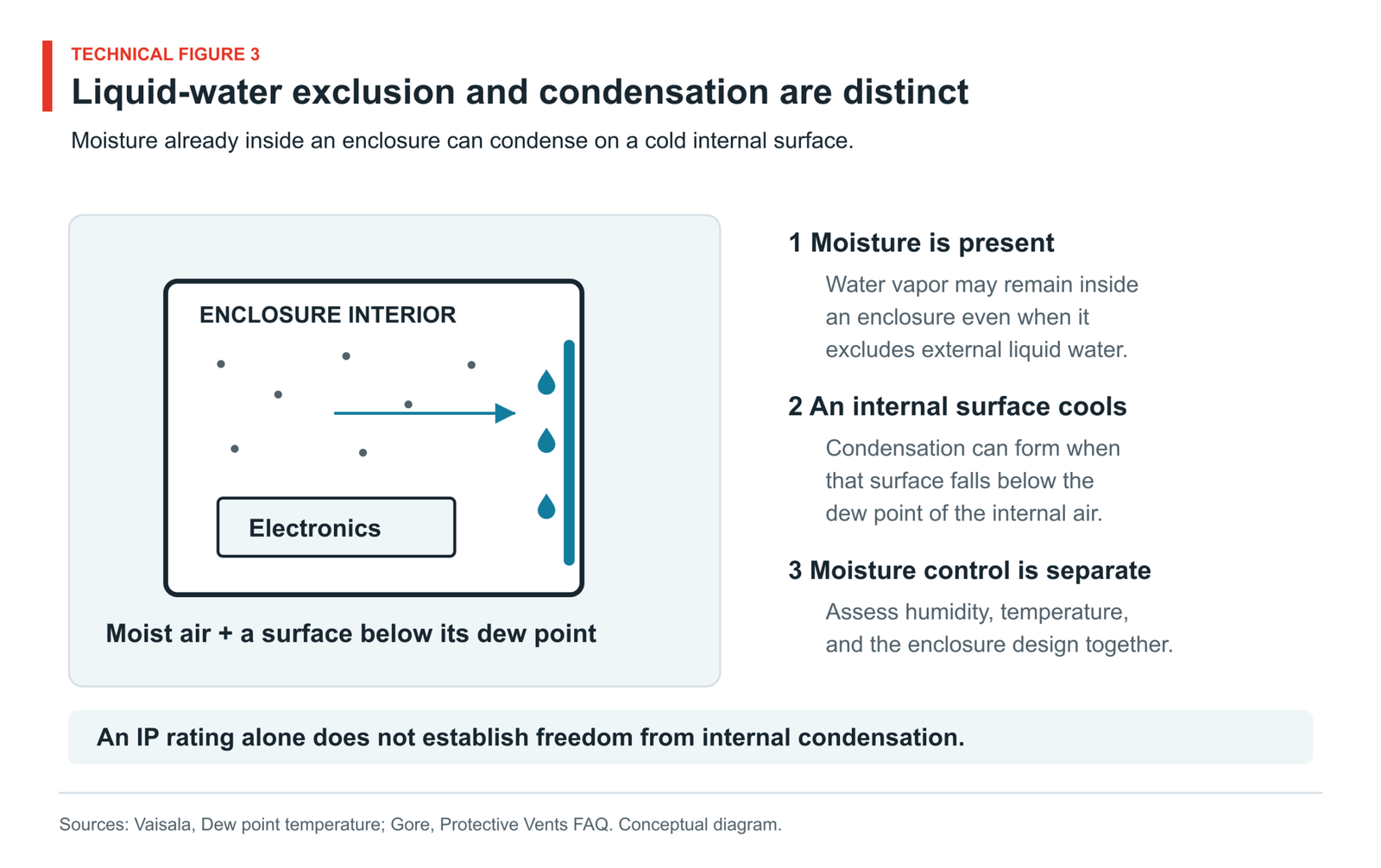
Liquid-water exclusion and internal moisture control are separate design functions. Gore identifies pressure differences as a source of stress on enclosure seals and connectors. Its technical guidance describes pressure equalization and moisture exchange as mechanisms for reducing that stress and helping control condensation. [3]
“The bidirectional air exchange enabled by these vents can also help reduce condensation.”
— W. L. Gore & Associates [3]
This supplier guidance supports a mechanism, not a universal vent requirement or service-life guarantee. The assessment must address the actual enclosure, heat sources, moisture conditions, and pressure-management strategy.
Figure 3. Internal moisture can condense on a surface below the dew point. An IP rating alone does not establish condensation control.
Salt Air and Corrosion
An IP designation does not establish coastal corrosion resistance. NEMA identifies additional hazards addressed by its enclosure requirements, including corrosion and external icing, and explains that its enclosure types and IP ratings are not fully equivalent. [2]
Corrosion reports should identify specimens, materials, conditions, duration, and acceptance criteria. An isolated coating or fastener result is not a qualification of the complete electronic assembly.
“Prediction of performance in natural environments has seldom been correlated with salt spray results when used as stand-alone data.”
— ASTM B117-26, §3.2 [4]
Salt-fog testing provides useful comparative evidence within a broader qualification program. It does not supply a universal conversion from laboratory hours to years of coastal service. [4]
Thermal Cycling and High-Dust Conditions
Freezing Conditions and Temperature Changes
Water-ingress protection does not independently establish cold-weather operation. UL Solutions treats climatic exposure, thermal shock, and ingress testing as distinct evaluations. Thermal shock examines rapid temperature changes, while ingress testing addresses water and solid-particle protection. [5]
A winter qualification plan should distinguish continuous cold operation, startup after a cold unpowered period, repeated temperature changes, moisture exposure, and external icing. These are proposed assessment conditions, not capabilities implied by IP65 or IP67. Storage limits should remain distinct from operating and startup limits.
Dust-Tight Protection and Dust-Storm Exposure
TÜV SÜD lists blowing sand and dust testing alongside other ingress-testing capabilities. This distinction supports identifying the actual particle exposure and test method for a high-dust installation. [6]
The proposed assessment should cover internal protection as well as exposed surfaces, ventilation paths, and service interfaces. A satisfactory result at one protective boundary does not establish satisfactory performance at every other boundary.
Reliability Evidence and MTBF
Mean Time Between Failures (MTBF) cannot be derived directly from an IP rating. Under a constant-rate model, NIST describes an MTBF estimate based on accumulated operating time divided by observed failures. Model assumptions and statistical uncertainty are essential to interpretation. [7]
A meaningful comparison requires consistent failure definitions, identified assembly boundaries, operating hours, comparable exposure, maintenance histories, sample sizes, and uncertainty estimates. Module failures and complete-display outages are different outcomes. The reviewed evidence does not support a numerical IP65-versus-IP67 MTBF differential for outdoor LED signs.
Specification and Operational Practices
Qualification Records
The technical record should connect each claim to an identifiable assembly and test. Ingress documentation should establish the rating and tested configuration. Environmental documentation should separately address corrosion, temperature, moisture, and site-specific stresses.
Installation and Service Conditions
Where protection depends on correctly installed gaskets, closed panels, or mated connectors, those conditions should be explicit in installation and maintenance instructions. Service procedures should restore the configuration represented by the qualification evidence.
Field Reliability Records
Laboratory qualification and field reliability should remain distinct. Testing demonstrates performance under specified conditions or exposes weaknesses. Field records describe failures during actual use. Neither evidence category should be presented as the other.
Limitations and Statement on Evidence
This paper draws on public testing guidance, standards-body summaries, engineering supplier information, and NIST reliability guidance. It distinguishes sourced statements from proposed assessment practices. It is not a certification, a substitute for complete test standards, or a performance guarantee. No NEXT LED product-specific test reports or field-failure datasets were available for this paper.
No single IP rating establishes suitability for every outdoor installation. The specification should identify expected dust and water exposures and the tested assembly. Corrosion, temperature, and moisture management require additional evidence. [1–3, 5]
How do digital signs withstand extreme winter weather?
Winter performance depends on suitable components, enclosure design, moisture control, and verified operation under the intended conditions. Ingress testing does not independently establish cold-start capability, resistance to thermal cycling, or performance under external icing. [3, 5]
Does an IP67 module make the complete sign IP67?
No. A module rating applies to the tested module assembly. Cabinet interfaces, wiring connections, and other compartments require their own supporting documentation before the same rating can be claimed for the complete display.
Does IP67 guarantee a longer service life than IP65?
No. An IP classification is not a service-life prediction. A reliability comparison requires defined failures, operating exposure, comparable conditions, and an appropriate statistical model. The reviewed sources do not establish a numerical MTBF advantage for IP67 outdoor LED signs. [7]